




A Constantly Growing Family
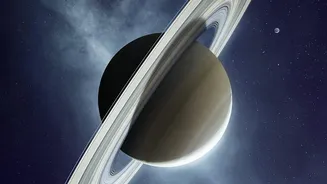
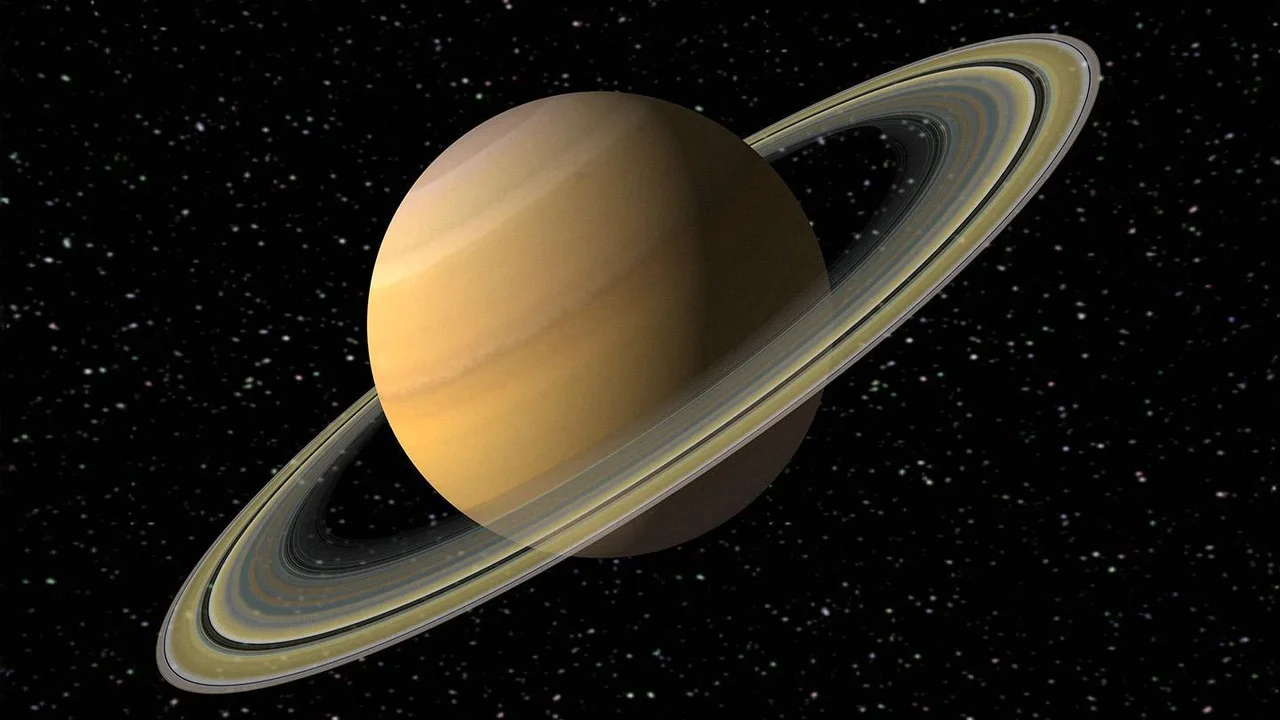
Forget what you learned in school; the number of Saturn’s moons is not a settled fact. As of August 2026, the official tally stands at a staggering 293 confirmed moons. This number has exploded in recent years, with huge batches of discoveries being announced.
For example, 128 new moons were recognized in March 2025 alone, and another 11 were added in March 2026. These discoveries have firmly established Saturn as the “moon king” of our solar system, far surpassing Jupiter. But these new family members aren’t giant spheres like Titan. Most are tiny, oddly shaped objects, some only a few kilometers across. They are what astronomers call “irregular moons,” and they hold clues to a violent, chaotic past in the outer solar system.
From Flybys to Digital Detective Work
For decades, our knowledge of Saturn’s moons came from groundbreaking but brief encounters. The Voyager probes flew by in the 1980s, giving us our first close-up images. Later, the Cassini spacecraft spent 13 years orbiting Saturn, revolutionizing our understanding and discovering several smaller moons nestled within the rings. But most of the recent discoveries haven’t come from a new spacecraft. Instead, they come from powerful ground-based telescopes, like the Canada-France-Hawaii Telescope, and a clever computational technique that can pull incredibly faint objects out of digital noise. The era of finding moons by simply looking through an eyepiece is long gone; today, it’s all about data processing.
The 'Shift-and-Stack' Method
The primary technique behind these recent discoveries is called “shift and stack.” Imagine trying to take a picture of a firefly in the dark. A single quick photo might not capture it, but a long exposure would just show a blurry streak. The same is true for tiny, distant moons. They are incredibly faint and they are constantly moving. The shift-and-stack method solves this problem. Astronomers take a series of sequential images of the sky around Saturn over several hours. A computer program then shifts each image to follow the predicted path of a hypothetical moon. When these shifted images are stacked on top of each other, the faint light from a real moon adds up, becoming a detectable point of light, while background stars become streaks. It’s a powerful way to make the invisible visible, allowing the detection of moons just 2.5 kilometers in diameter.
Confirming a Moon Is a Moon
Spotting a faint dot of light is just the first step. To be officially recognized as a moon, the object’s orbit must be confirmed. This is the job of the Minor Planet Center (MPC), the global body responsible for collecting data on new solar system objects. After a potential moon is detected, astronomers must track it over time to prove it's in a stable orbit around Saturn and not just a passing asteroid. The MPC calculates the object's likely path, cross-references it against all known objects, and determines if it is truly gravitationally bound to the planet. Once confirmed, the moon is given a provisional designation, like S/2023 S 51, before the discoverers can eventually propose a permanent name.
Why These Tiny Moons Matter
Finding these small, irregular moons is more than just a numbers game. Their strange, tilted, and distant orbits suggest they weren’t formed with Saturn but were instead captured by its immense gravity billions of years ago. Many of them are grouped by their orbits, indicating they are likely fragments of a few larger moons that were shattered by collisions. By studying these groupings, scientists can piece together the violent history of the Saturnian system and the evolution of the solar system as a whole. Each new discovery provides another data point for understanding the cosmic billiards that shaped the planets we see today.
The Next Frontier of Discovery
The hunt is far from over. Astronomers believe there are likely many more, even smaller moons waiting to be found. The next generation of observatories, particularly the Vera C. Rubin Observatory, is poised to revolutionize this search once again. Having begun its decade-long Legacy Survey of Space and Time in 2026, Rubin will scan the entire southern sky repeatedly, creating the most detailed map of the solar system ever made. Its unprecedented ability to detect faint, moving objects will likely reveal an even more crowded neighborhood around Saturn and the other giant planets, pushing the boundaries of what we know about our own cosmic backyard.