


Finding Countless New Worlds
Space is vast, and NASA's telescopes, like Kepler and the Transiting Exoplanet Survey Satellite (TESS), collect a staggering amount of data. Sifting through it all to find the tiny dip in a star's light that signals a passing planet is like finding a needle
in a cosmic haystack. This is where AI excels. Sophisticated algorithms like ExoMiner can analyze data from thousands of stars at once, spotting patterns that human eyes might miss. In recent years, AI has helped scientists confirm hundreds of new exoplanets, or planets outside our solar system. Systems like RAVEN, another powerful AI tool, have not only discovered brand new worlds but have also found rare planets in unusual orbits, helping to reshape our understanding of how solar systems form.
Smarter Rovers on Mars
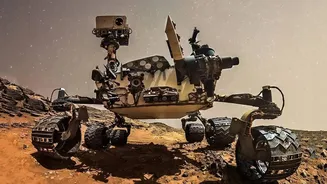
On Mars, there's a significant time delay for commands from Earth, making real-time control of rovers impossible. This is why AI-powered autonomy is a game-changer. The Perseverance rover uses AI to navigate the Martian landscape on its own, identifying hazards like rocks and sandpits and plotting the safest, most efficient path forward. In fact, a majority of Perseverance's driving is now done autonomously. In late 2025, the rover completed its first-ever drives where the entire route was planned by an AI, a major step toward more ambitious exploration of distant worlds. AI also helps the rover's scientific mission by autonomously selecting rock and soil targets for chemical analysis, speeding up the search for signs of ancient life.
Predicting the Sun’s Fury
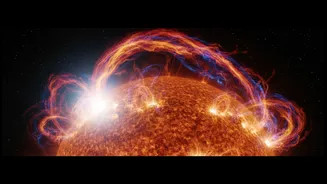
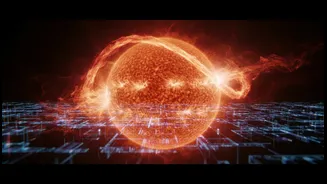
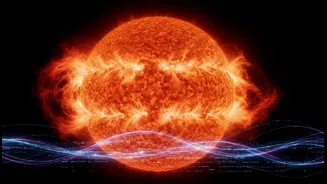
The Sun is not always calm. It can unleash powerful solar flares and storms that pose a threat to satellites, power grids, and even astronauts in space. Predicting this 'space weather' is crucial. NASA, in partnership with IBM, has developed an AI model named Surya, which analyzes years of solar imagery to detect patterns that precede a solar eruption. This model can forecast solar flares with greater accuracy and provide earlier warnings than previous methods. By making the model open-source, NASA is allowing scientists worldwide to help refine the technology, creating a better global shield against the Sun’s powerful outbursts.
An AI Doctor for Astronauts
For future long-duration missions to the Moon or Mars, astronauts won't have instant access to doctors on Earth. To solve this, NASA is working with Google to test an AI-powered medical assistant. Known as the Crew Medical Officer Digital Assistant (CMO-DA), this system is being trained to help astronauts autonomously diagnose and treat medical issues. By analyzing an astronaut's symptoms and health data, the AI can provide real-time guidance and support. Other AI assistants, like the free-flying CIMON on the International Space Station, are also being tested to help with complex tasks, monitor crew well-being, and reduce the workload, giving astronauts more time for research and relaxation.