






Breaking Down a Bizarre Calendar
On Earth, our concepts of a day and a year are simple. A day is one full rotation of our planet on its axis (24 hours), and a year is one full orbit around the Sun (about 365 days). On Venus, this fundamental relationship is flipped on its head. A single
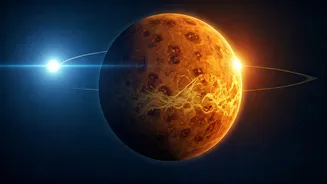
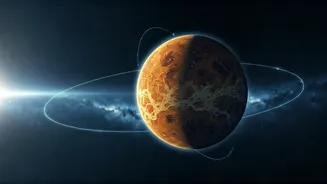
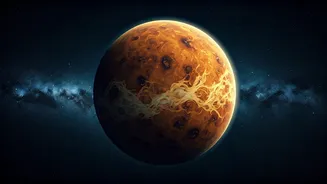
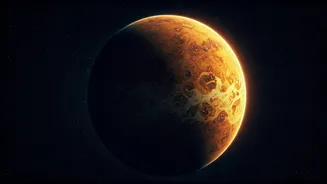
Venusian year—the time it takes to complete one orbit around the Sun—is approximately 225 Earth days. However, a single Venusian day—the time it takes for the planet to complete one rotation on its axis—is a staggering 243 Earth days. This means that if you were standing on Venus, a full year would pass before you experienced a single full day. It’s a concept so counter-intuitive that it continues to fascinate astronomers and planetary scientists.
Not Just Slow, But Backwards
The strangeness of Venus doesn't stop with its leisurely spin. It also rotates in the wrong direction. Most planets in our solar system, including Earth, have a prograde rotation, meaning they spin counter-clockwise on their axis when viewed from above the North Pole. Venus, along with Uranus, is an exception. It has a retrograde rotation, spinning clockwise. This means on Venus, the Sun rises in the west and sets in the east. This backward, sluggish rotation combines with its orbit to create another time-bending quirk: its solar day (the time from one sunrise to the next) is about 117 Earth days. While one full axial spin takes 243 days, the motion of the planet around the Sun means a spot on the surface only faces the Sun again after 117 days have passed.
The Mystery of the Slow Spin
So, why is Venus so peculiar? Scientists don't have a single definitive answer, but several compelling theories exist. One leading hypothesis points to its incredibly thick and heavy atmosphere. The Venusian atmosphere is about 92 times denser than Earth's, creating immense pressure. This dense, soupy atmosphere may be exerting a powerful frictional drag on the planet's surface, acting like a brake that has slowed its rotation over billions of years. Another theory suggests a history of cosmic violence. In the early, chaotic days of the solar system, a massive asteroid or planetary body could have slammed into Venus, not only slowing its spin but actually reversing it. A third idea involves a complex interplay of gravitational forces. It's possible that tidal forces from the Sun, combined with the atmospheric drag, locked the planet into its current, stable, but bizarre rotational state.
A Glimpse of a Hellish World
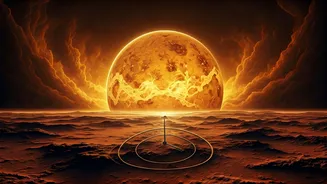
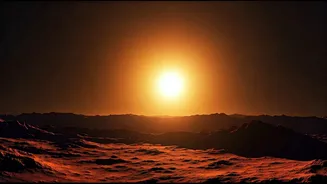
This slow rotation has profound consequences, contributing to Venus's status as the most inhospitable planet in the solar system. With a day that lasts for months, the Sun-facing side bakes for an extended period, while the night side experiences a prolonged, dark chill. However, the planet’s thick blanket of carbon dioxide creates a runaway greenhouse effect that traps heat with terrifying efficiency. This means there is very little temperature difference between day and night, or between the equator and the poles. The entire surface is a scorching, uniform 465°C, hot enough to melt lead. The slow rotation prevents the development of a strong global magnetic field, leaving the upper atmosphere exposed to the solar wind, which has stripped the planet of any water it may have once had.