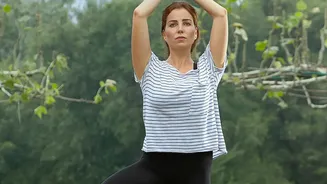



The Foundation: What is Mountain Pose?
Tadasana is the blueprint for ideal posture. It teaches you how to stand with stability, awareness, and balance by actively engaging muscles throughout the body. While it appears simple, this pose is an active process of aligning your body from the ground
up. It strengthens the legs and core, improves balance, and creates a sense of groundedness. By consciously aligning the body from the feet to the crown of the head, the pose encourages proper spinal curvature and engages core muscles, which can help alleviate back pain and neck tension over time.
Decoding 'Neutral Spine'
A 'neutral spine' doesn't mean your back should be perfectly straight. In fact, a healthy spine has three natural curves: a gentle inward curve at your neck (cervical), an outward curve at your mid-back (thoracic), and another inward curve at your low back (lumbar). A neutral spine is the position where these natural curves are maintained without exaggeration. Think of it as your body's ideal alignment, allowing for optimal breathing and muscle activation. Many people tend to either over-arch their lower back or tuck their tailbone too much, both of which move the spine out of its efficient, neutral state.
Finding Your Neutral Spine in Tadasana
To find your neutral spine, start by standing with your feet together or hip-width apart. Imagine your pelvis is a bowl of water. Tilt your pelvis forward, spilling water out the front (creating an exaggerated arch in your low back). Then, tilt it backward, spilling water out the back (flattening or rounding your low back). A neutral pelvis is the midpoint between these two extremes, where the 'water' is level. You should feel a slight, natural curve in your lower back. Another cue is to gently draw your belly button toward your spine to engage your core, which helps support this alignment.
The Role of the Shoulders
Just as important as the spine is the position of your shoulders. A common habit, both in yoga and daily life, is to let the shoulders round forward, which can cause the chest to collapse and create tension in the neck and upper back. In Tadasana, the goal is to create space across the collarbones. To do this, actively roll your shoulders up toward your ears, then draw them back, and finally let them relax down your back. Let your arms hang by your sides, with palms facing forward or alongside your body, and feel a sense of energy reaching down through your fingertips. This opens the chest, encourages deeper breathing, and aligns the head directly over the spine.
Common Misalignments and How to Fix Them
Being aware of common mistakes is key to refining your pose. One frequent error is locking the knees; instead, keep a tiny micro-bend in them to protect the joint. Another is uneven weight distribution in the feet. Press down firmly through the four corners of your feet: the ball of the big toe, the ball of the little toe, and the inner and outer edges of your heel. Many practitioners also forget to engage their legs. Actively lifting the kneecaps by engaging the quadriceps helps to create a stable foundation. Finally, avoid the tendency to either dramatically puff out the chest or slouch; the key is a balance between lifting the sternum and relaxing the shoulders down and back.