



A Sweet Discovery in Deep Space
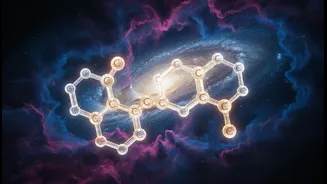
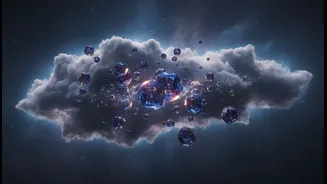
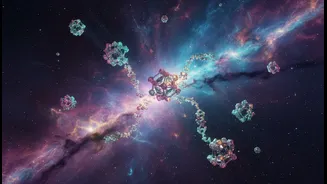
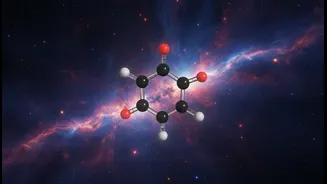
An international team of scientists has identified erythrulose, a four-carbon sugar, in a molecular cloud known as G+0.693-0.027. While the name might be a mouthful, on Earth this molecule is something quite familiar; it's a simple sugar found in red
raspberries and is also used in some sunless tanning products. This marks the first time a true sugar has been found in interstellar space. While other precursor molecules and even sugars like ribose have been found in meteorites that have landed on Earth, this is the first direct detection of such a complex sugar floating freely between the stars, long before it could be part of a planet.
Listening for Life's Ingredients
The discovery wasn't made with a traditional telescope that sees light. Instead, astronomers used powerful radio telescopes in Spain to listen for the faint radio signals that molecules emit in the cold, dark vacuum of space. Every molecule has a unique rotational fingerprint, a specific set of frequencies it gives off. By pointing the Yebes 40-m and IRAM 30-m telescopes toward the galactic center, researchers detected a pattern that perfectly matched the signature of erythrulose, which had been precisely measured in a laboratory. This allowed them to pick out the sugar's 'voice' from the cosmic noise.
The Building Blocks of Biology
Finding sugar in space is more than just a novelty; it's a profound clue in the search for the origins of life. Sugars are fundamental to biology as we know it. They are not only a source of energy for cells but are also crucial components of DNA and RNA, the molecules that carry the genetic instructions for all living things. Erythrulose itself isn't a direct part of DNA, but it is chemically related to the sugars that are and can be transformed into the ingredients that create the building blocks of RNA. This discovery shows that the universe is capable of making surprisingly complex, life-relevant molecules all by itself in the frigid expanse between stars.
A Delivery System for Life?
This finding provides strong support for a long-standing theory about how life on Earth may have begun. The raw ingredients for life may not have needed to form on our planet’s surface. Instead, they could have formed in interstellar clouds like this one. These molecules would then have been incorporated into the asteroids and comets that eventually coalesced to form our solar system. During a period known as the Late Heavy Bombardment, roughly 4 billion years ago, a constant barrage of these space rocks could have delivered vast quantities of sugars and other essential prebiotic chemicals to the young Earth, providing the feedstock for the first life to emerge.
What's Next for Astrochemistry
Led by astrochemist Izaskun Jiménez-Serra, the research team is excited by the implications. The fact that a four-carbon sugar like erythrulose was detected, while simpler three-carbon sugars were not, challenges some existing theories about how these molecules grow in complexity and suggests these interstellar chemical factories are even more efficient than previously thought. According to Carlos Briones, a co-author of the study, this discovery opens the door to finding even more complex sugars, like the five-carbon ribose that forms the backbone of RNA. Each new molecule identified adds another piece to the puzzle of how a lifeless cosmos could give rise to planets teeming with biology.