




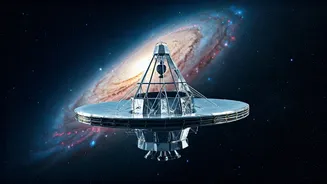
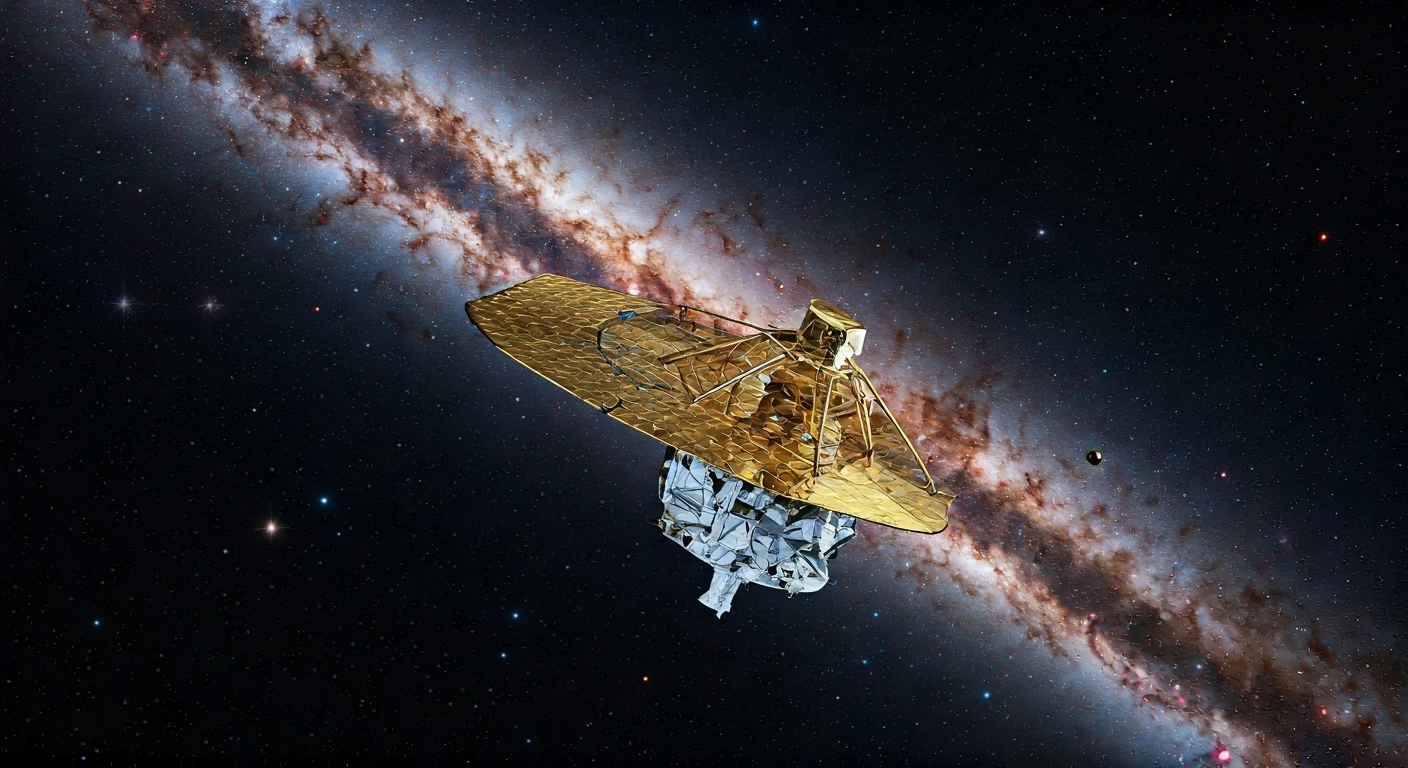


A New Cosmic Surveyor Arrives
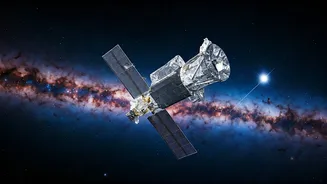
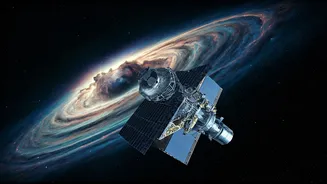
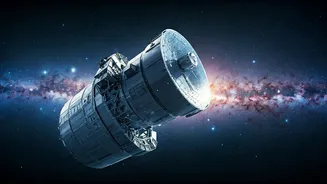
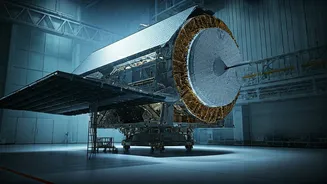
The "biggest moment" for NASA's next great observatory is rapidly approaching. The Nancy Grace Roman Space Telescope arrived at Kennedy Space Center in Florida on June 21, 2026, marking the start of final pre-launch preparations. [7, 11] After being assembled
and tested at NASA's Goddard Space Flight Center, the spacecraft traveled by barge to the Florida spaceport. [8] Teams will now conduct final checks, test its solar panels, and load about 290 gallons of hydrazine fuel for its journey. [4, 7] The mission is named after Dr. Nancy Grace Roman, NASA's first chief of astronomy, who is often called the "Mother of Hubble" for her foundational role in space-based observatories. [6, 9] The telescope is currently targeting a launch date no earlier than August 30, 2026, aboard a SpaceX Falcon Heavy rocket, putting the mission potentially months ahead of its official schedule. [4, 10]
A Panoramic View of the Universe
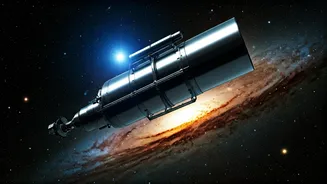
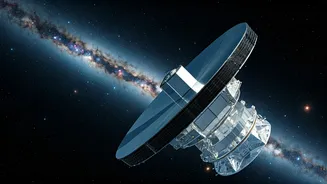
While it shares a 2.4-meter primary mirror—the same size as the Hubble Space Telescope's—Roman is a fundamentally different kind of observatory. [1, 5] Its revolutionary feature is its Wide Field Instrument (WFI), a 300-megapixel camera that gives it a field of view 100 to 200 times larger than Hubble's infrared camera. [1, 17] This vast field of view means that in a single snapshot, Roman can capture a patch of the sky larger than the apparent size of a full Moon. [16] This capability will allow it to map the sky at a blistering pace, surveying an area over 50 times larger than Hubble has in its entire 30-plus years of operation, all within its initial five-year mission. [16] It will essentially create panoramic, high-resolution maps of the infrared universe, a task that would take other telescopes centuries to complete. [16, 21]
Hunting for Dark Energy and New Worlds
Roman’s primary mission is to tackle two of the biggest mysteries in cosmology: dark energy and exoplanets. [3, 6] To investigate dark energy—the enigmatic force causing the universe's expansion to accelerate—Roman will measure light from hundreds of millions of galaxies. [1] By mapping their distribution and measuring how their light has been stretched over cosmic time, scientists can test theories about how dark energy has shaped the universe. [6] Its other key objective is a massive exoplanet census. It will use a technique called gravitational microlensing, where the gravity of a foreground star and its planets bend and magnify the light from a more distant star. [1] This method is sensitive enough to find planets down to a tenth of Earth's mass, including "rogue" planets that wander through space untethered to a star. [1]
A Complement to Webb and Hubble
Roman is not a replacement for the James Webb or Hubble space telescopes, but a powerful partner. [18, 19] While Webb is designed for deep, narrow dives into the early universe to study the first galaxies in incredible detail, Roman is a wide-angle survey instrument. [19, 20] Roman's strength lies in quickly scanning enormous sections of the sky to identify objects and patterns on a grand scale. [20] It can find the cosmic needles—like rare types of galaxies or planetary systems—in the vast haystack of the universe, which Webb can then study in greater detail. [19] In addition to its main surveys, Roman also carries a Coronagraph Instrument, a technology demonstration designed to directly image Jupiter-sized exoplanets by blocking the blinding light of their host stars. [1, 14]