





A Race Against the Clock
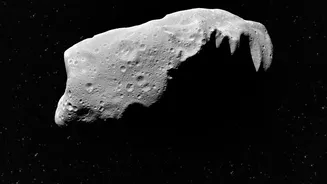
Imagine spotting a tiny, fast-moving object hurtling towards Earth. This is the reality for astronomers who discover what are known as 'imminent impactors'. These are typically small asteroids, often just a metre or two in diameter, that are only visible
when they get very close. The moment one is identified, an international network of observatories and scientists springs into action. For example, when asteroid 2024 BX1 was discovered just three hours before it impacted over Germany, observatories across Europe scrambled to gather as much data as possible. This rapid response is a testament to the growing coordination of global asteroid tracking systems. In a few short hours, scientists work to precisely calculate the asteroid's trajectory, estimate its size and rotation, and alert the scientific community to prepare for a spectacular light show and, hopefully, a meteorite hunt.
Pinpointing the Impact Zone
One of the most immediate benefits of detecting an incoming asteroid is the ability to predict exactly where it will land. Even with only a few hours of tracking data, scientists can calculate the impact corridor with astonishing precision. For asteroid 2023 CX1, which entered the atmosphere over Normandy, France, the predicted trajectory was accurate to within 20 metres. This incredible accuracy transforms a random meteor event into a predictable one. It allows authorities to be notified and ensures public safety, as even small asteroids can create startling fireballs. More importantly for science, knowing the impact zone, or 'strewn field', is the first step in a much larger treasure hunt: the quest to recover the meteorites that survive the fiery descent.
The Holy Grail: Linking Meteorite to Asteroid
Meteorites are found on Earth all the time, but the vast majority are 'orphans'—we have no idea where in the solar system they came from. An asteroid detected before impact changes all of that. It provides a direct, verifiable link between the object observed in space and the rock that can be held and analysed in a lab. This is the holy grail of asteroid science. When fragments of 2024 BX1 were recovered near Berlin, they were quickly identified as aubrites, a rare type of meteorite. Scientists were even able to predict this composition before the fragments were found, based on analysis of the fireball's light spectrum. Studying these recovered pieces allows us to understand the asteroid's origin, age, and chemical makeup, providing a pristine sample of the building blocks of our solar system from 4.5 billion years ago.
A Real-World Fire Drill
These small, harmless impactors serve as invaluable, real-world tests for planetary defense. Each event, from detection to recovery, is a full-scale drill for the systems designed to protect us from a much larger, more threatening object. Scientists get to test their detection software, coordination protocols, and prediction models. The study of how these small bodies break up in the atmosphere also provides crucial data. For instance, analysis of 2023 CX1 showed it fragmented in an unusually abrupt way, releasing its energy in a concentrated burst. Understanding this behaviour helps refine models of atmospheric entry, which is critical for assessing the potential ground damage from a larger asteroid, like the one that exploded over Chelyabinsk in 2013.
Unlocking Solar System Secrets
Ultimately, every recovered piece of a pre-detected asteroid is a time capsule. The analysis of meteorites from asteroids like 2008 TC3 in Sudan or 2024 BX1 in Germany has provided unprecedented insights. We learn about the diversity of materials in the asteroid belt, the violent history of collisions that shape these bodies, and the physical stresses they can endure. By tracing their orbits back, we can even pinpoint which part of the asteroid belt they came from, linking them to larger 'parent' bodies. These small rocks answer some of the biggest questions about how our solar system formed and evolved, and how the materials for life may have been delivered to Earth.