





Meet Mission Shukrayaan
After the historic successes of missions to the Moon (Chandrayaan) and Mars (Mangalyaan), ISRO is embarking on its next great interplanetary adventure: a mission to Venus. Dubbed Shukrayaan-1, which translates to 'Venus Craft', this ambitious project
involves sending a 2500 kg spacecraft to orbit the planet. The orbiter is planned to carry a suite of advanced instruments designed to peer beneath Venus's thick, mysterious cloud cover and study its hostile environment. With a proposed launch date in 2028, Shukrayaan-1 signals India’s intent to join an elite club of space agencies exploring the second planet from the sun. It represents a logical and bold next step in deepening our understanding of the solar system.
A Tale of Two Planets
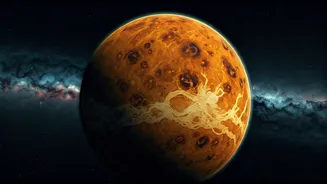
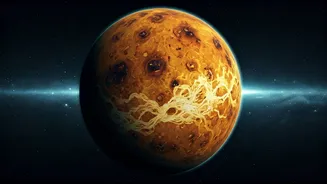
Venus is often called Earth's twin because the two planets share so much in common. They are similar in size, mass, and composition, and they were formed in the same part of the solar system. But that’s where the similarities end. Venus is the hottest planet in our solar system, with surface temperatures of around 460 degrees Celsius—hot enough to melt lead. Its atmosphere is over 90 times denser than Earth's and is composed almost entirely of carbon dioxide, with thick clouds of sulfuric acid. This creates a runaway greenhouse effect, trapping heat and making the surface utterly inhospitable. Understanding why this twin took such a catastrophic developmental path while Earth thrived is a key driver of modern planetary science.
The Scientific Questions
The primary goal of Shukrayaan-1 is to understand the complex processes that shape Venus. The mission will investigate the planet's surface and subsurface, mapping its geology to search for signs of active volcanoes. A key objective is to study its super-rotating atmosphere, where winds whip around the planet in just four Earth days. Additionally, the orbiter will analyze the interaction between the solar wind and Venus's ionosphere, which is crucial for understanding how the planet lost its water and became so dry. Some instruments will even search for clues related to the potential for microbial life in the planet's upper, cooler cloud layers, following the intriguing detection of phosphine gas in 2020.
A Formidable Challenge
Exploring Venus is one of the toughest challenges in space exploration. The extreme heat, crushing atmospheric pressure, and corrosive acid clouds make it incredibly difficult for any spacecraft to survive. The longest any probe has ever lasted on the Venusian surface is just over two hours, a record set in 1981. For Shukrayaan-1, an orbiter, the challenges include withstanding intense thermal conditions, ensuring precise orbital insertion, and maintaining high-bandwidth communication for data transfer from deep space. Overcoming these hurdles will be a testament to ISRO's growing engineering and technological prowess, building on lessons from its previous interplanetary missions.
Why This Matters for India and Earth
The Shukrayaan-1 mission is more than just a scientific quest; it is a strategic priority for India. It solidifies the nation's standing as a major player in space exploration and opens up new avenues for international collaboration, with several payloads being developed with partners from Russia, France, Sweden, and Germany. Furthermore, studying Venus offers a unique window into planetary evolution. By understanding the runaway greenhouse effect that transformed Venus, scientists can improve climate models for our own planet, offering vital insights into Earth's potential future. It’s a mission that looks outward to another world to better understand our own.