


Sailing on Sunbeams
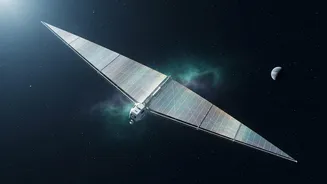
Imagine a sailboat on the ocean, its sails catching the wind to move forward. A solar sail works on a similar principle, but its 'wind' is sunlight. Light is made of tiny particles called photons which, despite having no mass, carry momentum. When these
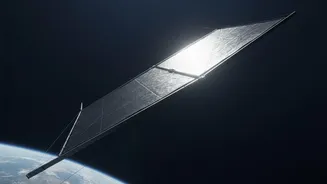
photons bounce off a large, mirror-like sail in the vacuum of space, they transfer that momentum, giving the spacecraft a tiny, continuous push. While the force from a single photon is minuscule, the constant stream from the sun provides a gentle but unrelenting acceleration. Unlike chemical rockets which provide short, powerful bursts, a solar sail accelerates slowly but steadily, capable of reaching immense speeds over long periods.
Lighter, Bigger, Better
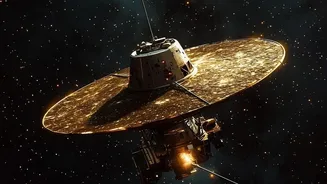
To be effective, a solar sail must be incredibly large to catch enough sunlight, but also astonishingly light to be pushed by it. This engineering challenge has led to the development of remarkable new materials. Most sails are made from ultra-thin, reflective films like Mylar or polyimide, coated with a layer of aluminum. The Planetary Society's successful LightSail 2 mission used a sail just 4.5 microns thick — thinner than a human hair — that unfolded to the size of a boxing ring. More recently, NASA's Advanced Composite Solar Sail System (ACS3), launched in 2024, is testing booms made of lightweight carbon fiber composites. These new materials are not only 75% lighter than metal booms but are also designed to be stronger and less prone to warping in the extreme temperatures of space, paving the way for future sails as large as a basketball court or even bigger.
Breaking Free from Rocket Fuel
The biggest advantage of solar sailing is that it eliminates the need for propellant. Conventional spacecraft are limited by the amount of fuel they can carry, a constraint known as the 'tyranny of the rocket equation'. Most of a rocket's mass is the fuel needed to lift its own fuel. Solar sails, on the other hand, have what rocket scientists call an infinite specific impulse because they don't consume any onboard propellant. The sun provides the power for free. This dramatically reduces mission cost and complexity, allowing for spacecraft that are lighter at launch and can operate for much longer. By ditching heavy fuel tanks and complex engines, more of the spacecraft's mass can be dedicated to scientific instruments.
A Technology Takes Flight
Once a concept confined to science fiction, solar sailing is now a proven technology. Japan’s IKAROS probe was the first to successfully use a solar sail for propulsion in interplanetary space during its 2010 journey toward Venus. The Planetary Society’s crowdfunded LightSail 2 mission further proved the concept in Earth orbit from 2019 to 2022, successfully using sunlight to change its altitude. The latest demonstrator, NASA's ACS3, is now testing next-generation deployment systems and composite materials in orbit. Though it encountered a minor bend in one of its booms upon deployment, the mission has successfully unfurled its large sail and is providing crucial data for future designs. Each mission builds on the last, refining the techniques needed to reliably navigate the solar system on light.
The New Horizons Awaiting
Fuel-free propulsion opens up missions that are currently difficult or prohibitively expensive. Solar sails are ideal for long-duration journeys, like sending probes to study asteroids, observe the sun from unique orbits, or travel to the outer planets. Because they can provide continuous thrust, sails can be used to hold a spacecraft in an otherwise unstable position, such as a spot closer to the sun to provide earlier warnings of solar storms. For interstellar travel, solar sails are one of the only viable technologies known today. While current sails rely on the sun, future concepts involve pushing vast, lightweight sails with powerful ground-based lasers, potentially accelerating a probe to a significant fraction of the speed of light and reaching the nearest star system, Alpha Centauri, in decades rather than millennia.