






Choose Wisely and Time It Right
Effective sun protection begins before you even open the bottle. Dermatologists recommend choosing a broad-spectrum sunscreen with an SPF of 30 or higher. Broad-spectrum means it protects against both UVA (ageing) and UVB (burning) rays. Once you have
your product, timing is everything. It takes about 15 to 30 minutes for sunscreen to be absorbed by your skin and provide protection. Applying it just before you step outside leaves your skin vulnerable. Make it the last step of your morning skincare routine, after your moisturiser, to give it time to form a protective layer.
The 'Enough' Question: How Much to Use
One of the most common mistakes is not using enough sunscreen. To achieve the SPF level advertised on the bottle, you need to apply a surprisingly generous amount. For your entire body, the recommendation is about one ounce, which is equivalent to a shot glass full. For just the face and neck, a helpful guideline is the 'two-finger' rule: squeeze a line of sunscreen along the length of your index and middle fingers. This typically amounts to about half a teaspoon. Applying less than this can drastically reduce the effectiveness of your SPF.
Mastering the Method and Covering All Bases
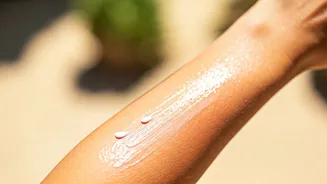
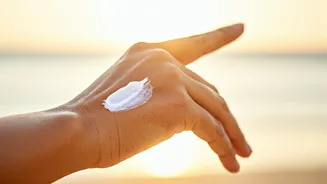
How you apply sunscreen matters. Start by shaking the bottle to ensure the protective ingredients are evenly mixed. Apply it to all skin that will be exposed to the sun. People commonly miss spots like their ears, the back of their neck, the tops of their feet, the back of their hands, and along their hairline and scalp parting. These neglected areas are just as susceptible to sun damage. For your face, it's best to apply sunscreen by dotting it around before gently rubbing it in to ensure an even, consistent layer.
Lotions, Sprays, and Sticks, Explained
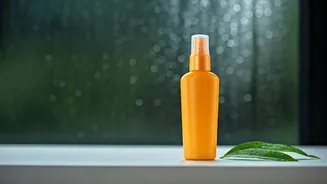
Different sunscreen formulas require slightly different application techniques. Lotions are excellent for dry skin and the face, as they provide controlled and visible coverage. Sticks are great for the delicate eye area and for reapplying on the backs of hands. When using a stick, dermatologists recommend four back-and-forth passes on the skin, followed by rubbing it in for evenness. Sprays offer convenience, especially for large body areas or on children, but they are often applied incorrectly. To use a spray effectively, hold the nozzle close to your skin, spray until there's an even sheen, and then rub it in thoroughly to cover any missed spots. Never spray sunscreen directly on your face; spray it into your hands first and then apply it.
The Reapplication Rule: Don't Forget It
Sunscreen is not a one-and-done deal. Its protective power wears off over time. The golden rule is to reapply every two hours when you're outdoors. This rule applies regardless of the SPF number; a higher SPF doesn't mean it lasts longer. You need to reapply more frequently—perhaps every 45 to 80 minutes—if you are swimming, sweating heavily, or after you towel dry, as these activities can wash off or remove the product. Even on days spent mostly indoors, it's wise to reapply every four to six hours if you're sitting near a window, as UVA rays can penetrate glass.