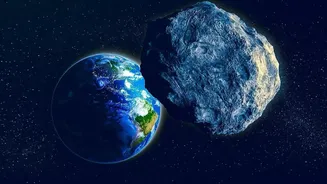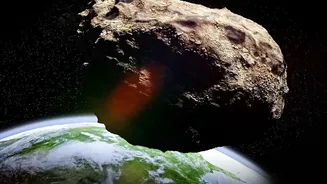

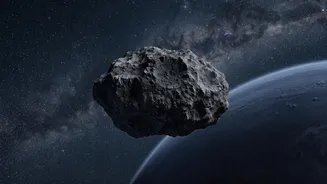
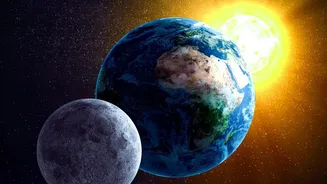
For the past several months, Earth has had a secret companion. Far beyond our atmosphere, a small asteroid designated 2026 QQ8 has been our silent fellow traveller. Now, its time with us is ending, offering a final wave goodbye.
A Fleeting Cosmic Companion
In early 2026, astronomers
using sky-survey telescopes detected a faint object moving in a peculiar way. After several weeks of observation to confirm it wasn't old rocket debris, it was identified as a small, natural asteroid and given the name 2026 QQ8. Measuring only a few metres across, this space rock was never a threat, but it was a source of great scientific curiosity. It had been gently captured by Earth's gravitational influence, becoming what is known as a temporary 'mini-moon'. These objects are not uncommon, with scientists estimating Earth hosts at least one at any given time, though most are too small and faint to be easily found.
Not a Moon, But a Fellow Traveller
While terms like 'mini-moon' or 'second moon' are catchy, 2026 QQ8 is more accurately described as a quasi-satellite. Unlike our Moon, which is gravitationally locked in a stable orbit around Earth, a quasi-satellite is an asteroid that orbits the Sun on a path very similar to our own. From our perspective on a moving Earth, this creates the illusion that the object is looping around us. Imagine two cars driving in adjacent lanes on a vast circular track at almost the same speed. For a while, they travel alongside each other, but they aren't tied together. 2026 QQ8 was simply in the next lane over, cosmically speaking, its path kept close by a delicate gravitational dance with Earth.
The Hunt for Hidden Neighbours
Discovering objects like 2026 QQ8 is a testament to the power of modern planetary defence and sky survey programs. Observatories like the Pan-STARRS in Hawaii and the Catalina Sky Survey constantly scan the night sky, taking multiple images of the same patch of space minutes apart. Computers then analyse these images, flagging any speck of light that moves against the fixed background of stars. Once a potential Near-Earth Object (NEO) is flagged, astronomers around the world perform follow-up observations to plot its trajectory and determine its nature. This global network is crucial for cataloging asteroids, assessing potential impact risks, and finding scientifically interesting objects like our temporary companion.
A Window into the Solar System
Though its visit was short, 2026 QQ8 provided a valuable scientific opportunity. Studying quasi-satellites and mini-moons offers clues about the makeup of the early solar system. These objects are essentially time capsules. Some are thought to be fragments from the main asteroid belt between Mars and Jupiter, while others might even be pieces of our own Moon, blasted into space by ancient impacts. By analysing the sunlight that reflects off their surface, scientists can determine their composition without ever leaving Earth. Each new observation helps build a clearer picture of the diverse population of rocks that share our cosmic neighbourhood.
A Quiet Farewell
After months of looping around our planet, 2026 QQ8 is now on its farewell tour. Its departure is not a dramatic event; it is simply drifting to the edge of Earth's sphere of gravitational influence. The delicate balance that kept it nearby will tip, and the small asteroid will gently continue on its own independent orbit around the Sun. Astronomers will track it for as long as they can, refining our understanding of how these temporary captures work. While it may return to our vicinity in a few decades, its time as Earth's mini-moon is over.