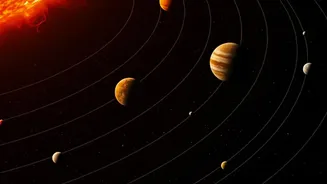


Our solar system feels like a place of cosmic certainty, with planets held in a stable gravitational ballet. But new research into the Sun's final, chaotic moments suggests this stability has an expiration date, and it may arrive much sooner than we ever
imagined.
The Sun's Inevitable Decline
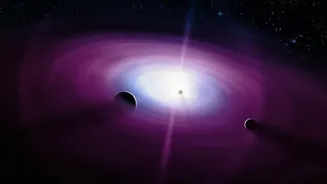
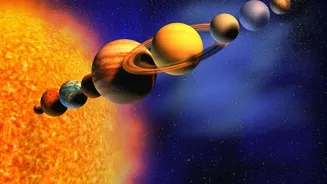
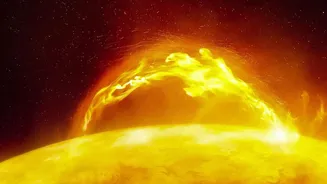
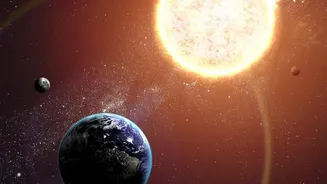
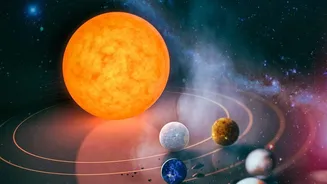
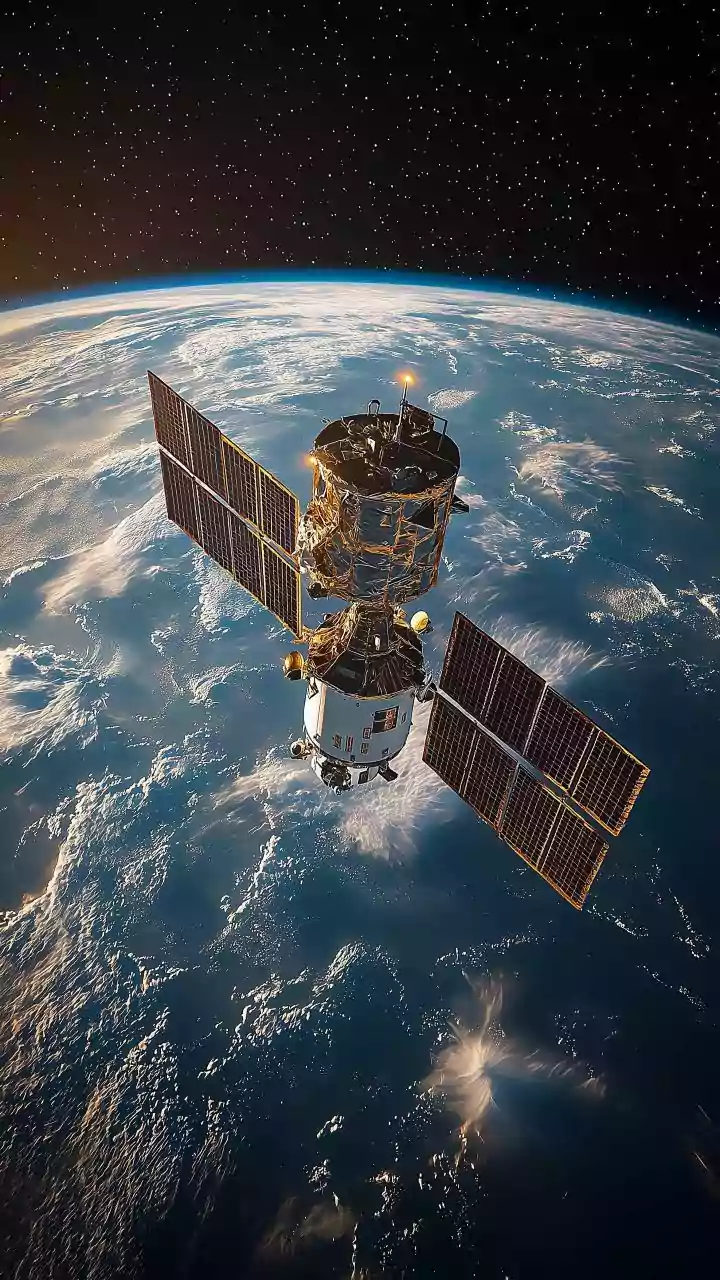
Like all stars, our Sun has a finite lifespan. For the past 4.6 billion years, it has been in its 'main sequence' phase, fusing hydrogen into helium in its core. But in about five billion years, that hydrogen fuel will run out. The Sun's core will contract and heat up, causing its outer layers to puff up dramatically. It will swell into a red giant, expanding its atmosphere to potentially 100 times its current size. In this phase, it is expected to engulf and vaporise the inner planets: Mercury, Venus, and very likely Earth. Following this expansion, the Sun will shed its outer layers and collapse into a white dwarf, a dense, cooling stellar remnant about the size of our planet.
An Uneven and Messy End
For decades, most models of the Sun's death assumed it would lose mass in a smooth, spherically uniform way. This gentle process would cause the remaining planets' orbits to widen, but the system's overall architecture would remain stable for an incredibly long time—perhaps for 100 billion years or more. However, a recent study published in The Astrophysical Journal Letters challenges this tidy picture. Researchers now propose that the Sun will not fade away quietly. Instead, it will shed its mass in thousands of violent, uneven bursts, ejecting massive clumps of plasma in random directions. Each ejection will act like a tiny rocket engine, giving the Sun a small 'kick' or recoil. While a single kick is minor, the cumulative effect of thousands of these random nudges could send the dying Sun on an erratic path, fundamentally altering its gravitational influence.
A Cosmic Pinball Machine
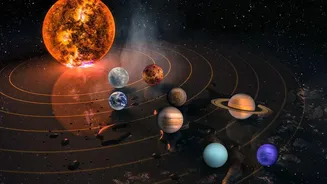
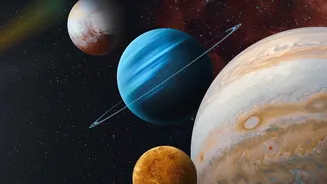
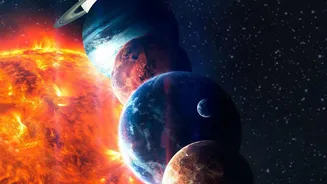
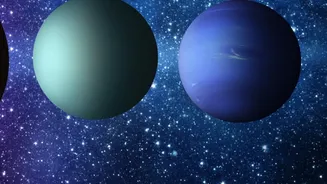
To understand the consequences, scientists ran hundreds of computer simulations modeling this 'stochastic' or random mass loss. The results paint a picture of chaos. As the Sun’s gravitational center shifts with each kick, the delicate balance holding the outer planets in their orbits is broken. The giant planets—Jupiter, Saturn, Uranus, and Neptune—would be thrown into disarray. Instead of drifting gently outward into new, stable orbits, they would begin to perturb one another violently. The simulations showed planets swapping orbits, being flung onto highly elliptical paths, or being ejected from the solar system entirely. This creates a far more violent and unpredictable end for our solar system, turning the once-orderly outer realm into a chaotic gravitational pinball machine.
A Radically Shorter Timeline
Perhaps the most startling finding is how quickly this chaos could unfold. Previous models suggested the outer solar system could remain stable for up to a quintillion years. The new simulations dramatically shorten that timeline. This instability could begin to emerge even while the Sun is still in its red giant phase. In the most extreme scenarios, where the ejected mass packets are largest, a staggering 96% of simulations resulted in the giant planets eventually colliding and destroying each other. The study concludes that the outer solar system's stability is likely to break down within just a few billion years after the Sun becomes a white dwarf—a lifespan a billion times shorter than some previous estimates.