







The Coolest Lab in Space
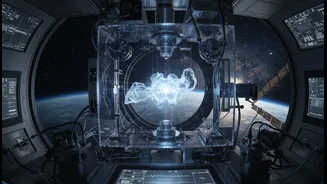
Orbiting Earth on the International Space Station is a mini-fridge-sized facility doing some of the coldest science imaginable. This is NASA's Cold Atom Lab (CAL), and its mission is to study the bizarre world of quantum mechanics by chilling atoms to temperatures
just a fraction above absolute zero—the coldest possible temperature in the universe. At these extremes, atoms slow to a near-standstill and form a strange fifth state of matter called a Bose-Einstein Condensate (BEC). In a BEC, countless individual atoms lose their identity and behave as a single, massive quantum wave. The microgravity of space is the perfect place for this, as it allows scientists to observe these delicate quantum states for longer periods than on Earth.
A Major Quantum Leap Forward
The Cold Atom Lab, operational since 2018, recently received its fourth and most significant upgrade. Installed by astronauts, the new hardware includes a redesigned magnetic trap to better contain and shape the atom clouds, along with improved instruments for creating and measuring them. This enhancement allows scientists, who operate the lab remotely from Earth, to probe the quantum world with greater precision. The upgrade enables new types of experiments that could lead to a deeper understanding of the fundamental laws of physics and test quantum phenomena in ways simply not possible in a terrestrial lab. It's a critical step in maturing the tools needed for future space-based quantum instruments.
The Alluring Promise of Quantum Tech
Research like that done at the Cold Atom Lab fuels the immense excitement around quantum technology. The promise is revolutionary: quantum computers that could solve problems currently intractable for even the most powerful supercomputers, ultra-precise quantum sensors for navigation and detecting gravitational waves, and new materials designed at the atomic level. Quantum principles like superposition (where a particle can be in multiple states at once) and entanglement (a mysterious link between particles) are the engines behind these potential breakthroughs. Ultimately, mastering these phenomena could transform everything from medicine and finance to climate modeling and cryptography.
Bridging the Chasm to Reality
Here's the reality check. A physics experiment in a highly controlled lab—even one as advanced as CAL—is fundamentally different from a commercially deployed system. Building a useful, large-scale quantum computer, for example, faces immense practical hurdles. One of the biggest is decoherence, where the fragile quantum state of qubits (the basic unit of quantum information) is destroyed by the slightest environmental noise, like heat or vibration. Today's quantum processors are error-prone and require extreme cooling to near absolute zero, making them expensive and difficult to scale. While a lab might prove a concept, turning it into a reliable product that can be integrated into existing tech stacks is a monumental engineering and financial challenge that will likely take many more years, if not decades.
Why This Lab Research Still Matters
The need for a reality check doesn't diminish the importance of the Cold Atom Lab's work. It represents a vital part of the scientific process: building a deep, foundational understanding. Every major technological revolution, from electricity to the internet, was built upon decades of fundamental research that often had no immediate commercial application. The experiments on the ISS are not meant to produce a quantum laptop next year. Instead, they are providing the crucial data and insights that will inform the next generation of engineers and inventors. By pushing the boundaries of what we know, the CAL is laying the essential groundwork for the quantum technologies of the future, even if that future remains distant.