
Our planet is constantly bombarded by invisible particles from space, some carrying more energy than anything created on Earth. These cosmic rays are messengers from violent events, and learning to read their signals is unlocking our galaxy's history.
The Universe's Most Energetic Particles
Cosmic rays are not actually 'rays' in the traditional sense, but rather atomic nuclei—mostly protons—that have been accelerated to nearly the speed of light. They originate from some of the most cataclysmic events in the universe, such as supernova explosions, active galactic nuclei, and pulsars. The energy they carry is immense, millions of times greater than particles in the Large Hadron Collider. This incredible energy means they hold clues about their violent birthplaces, but their electrically charged nature makes them tricky to trace. As they journey across the galaxy, their paths are scrambled by magnetic fields, making it impossible to simply look back and see where they came from.
Catching a Ghost in the Atmosphere
So how do you observe a single, invisible particle? The ingenious solution is to not look for the cosmic ray itself, but for its dramatic entrance into our atmosphere. When a high-energy cosmic ray smashes into air molecules, it triggers a cascade of secondary particles, creating a phenomenon known as an extensive air shower. These showers can spread out over many square kilometres by the time they reach the ground. As the particles in this shower race downwards—faster than the speed of light in air—they produce a faint, fleeting flash of blueish-ultraviolet light called Cherenkov radiation. This ghostly glow, lasting only a few nanoseconds, is the key to 'seeing' the unseeable.
Telescopes Designed for a Flash
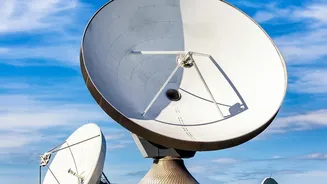
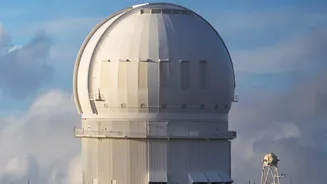
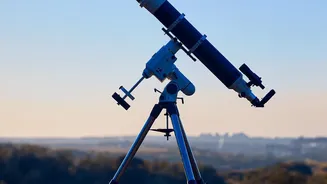
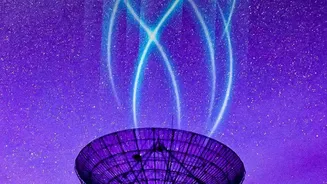
Detecting this faint flash requires incredibly specialised equipment. Imaging Atmospheric Cherenkov Telescopes (IACTs) are arrays of huge, mirrored dishes designed to act like giant light buckets. Observatories like the High Energy Stereoscopic System (H.E.S.S.) in Namibia and the upcoming Cherenkov Telescope Array Observatory (CTAO) use multiple telescopes to view the same air shower from different angles. This stereoscopic vision allows scientists to reconstruct the shower's trajectory and pinpoint its origin in the sky with unprecedented accuracy. Other experiments, like the Pierre Auger Observatory in Argentina, use a hybrid approach, combining fluorescence detectors that see the faint UV light from nitrogen in the air with a vast network of water tanks that detect the shower particles directly when they hit the ground.
Decoding the Secrets of Galaxy Evolution
By studying these signals, astronomers can piece together a story of galactic evolution. Since cosmic rays are born from the life and death of massive stars, their prevalence is tied to the rate of star formation. Galaxies with high star formation rates, especially in the early universe, are expected to be rich in cosmic rays. These particles do more than just exist; they actively shape their environment. They inject enormous amounts of energy and pressure into the interstellar medium, influencing how gas clouds collapse to form new stars and potentially driving powerful galactic winds that can regulate or even halt star formation in a galaxy—a process called 'feedback'. By observing the gamma rays produced when cosmic rays interact with interstellar gas, scientists can map out these processes and understand the delicate balance that governs a galaxy's life cycle.