




First, What Is a Super-Earth?
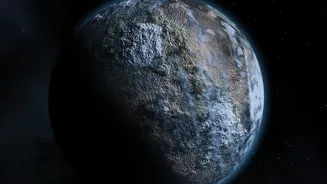
Imagine a planet more massive than Earth but lighter than Neptune. That’s a Super-Earth. These planets are a class unlike any in our solar system and are surprisingly common in our galaxy. The term 'Super-Earth' refers only to a planet's size and mass —
typically up to twice Earth's size and ten times its mass — not that it's Earth-like. They could be rocky worlds, gas dwarfs, or even water worlds covered in deep oceans. Because they are so prevalent, they have become prime targets for astronomers trying to understand the diversity of planets and the potential for life elsewhere.
The Infrared Detective: Spectroscopy
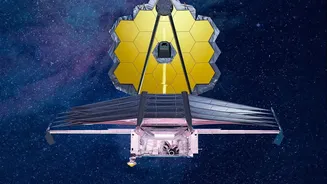
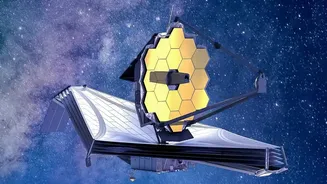
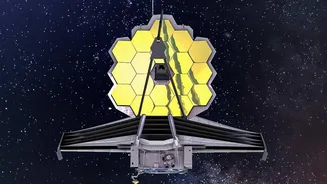
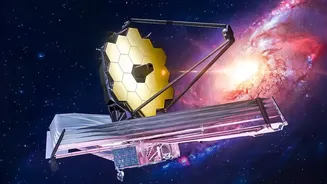
To study a planet hundreds of light-years away, scientists become cosmic detectives. Their main tool is a technique called transit spectroscopy. When an exoplanet passes in front of its host star from our point of view, it causes a tiny dip in the star's brightness. For a brief moment, some of the starlight filters through the planet's atmosphere before it reaches our telescopes. This is where infrared sensors, like those on the James Webb Space Telescope (JWST), come into play. They are specially designed to analyze this filtered light.
Decoding an Atmospheric Fingerprint
Think of the starlight as a pure, white light containing a full spectrum of colors, including infrared. When that light passes through an atmosphere, molecules in the gas absorb very specific wavelengths, or colors, of that light. Every molecule, whether it's methane, carbon dioxide, or water vapor, has a unique absorption pattern — a chemical 'fingerprint'. Infrared sensors are incredibly sensitive to these patterns. By looking at which infrared wavelengths are missing from the starlight after it passes through the atmosphere, scientists can determine which molecules are present. It’s like seeing a barcode that reveals the atmospheric composition.
Why Water Vapour Is a Big Deal
Finding water vapor is a landmark discovery in the study of exoplanets. Water is a fundamental ingredient for life as we know it, so detecting its presence in a planet's atmosphere is a critical first step in assessing potential habitability. The detection of water vapor on a rocky planet would suggest that the building blocks for life could be present. However, finding water vapor doesn't automatically mean a planet has liquid oceans or is habitable. A planet could be too hot, like Venus, resulting in a steamy, inhospitable world. For example, observations of the super-Earth GJ 486 b showed hints of water, but the planet's surface is a scorching 430 degrees Celsius.
The Challenge: Planet or Star?
Detecting these signals is incredibly difficult and comes with major challenges. One of the biggest puzzles for scientists is confirming the source of the water vapor. As researchers studying GJ 486 b pointed out, the signal could be coming from the planet's atmosphere, or it could be originating from the star itself. Some cooler stars, known as red dwarfs, can have water vapor in cool regions on their surface called starspots. This can create a false signal that mimics a planetary atmosphere. Scientists must carefully model and conduct follow-up observations with multiple instruments to be sure the water they are seeing truly belongs to the planet.