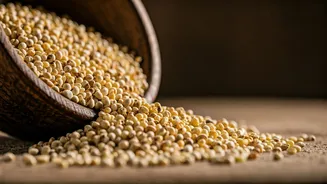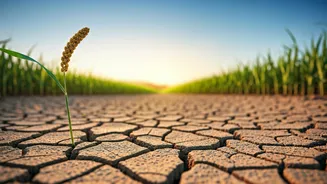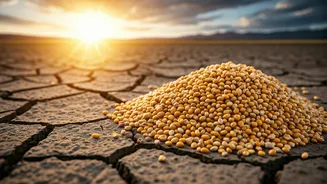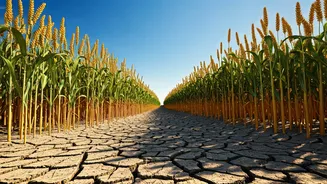








What Makes Millets 'Rain-Smart'?
Millets are exceptionally hardy and well-suited for India's semi-arid regions. Their primary advantage lies in their low water requirement compared to other Kharif staples like rice and sugarcane. [2, 24] For example, producing one kilogram of rice can require 2,800
to 5,000 litres of water, whereas millets can thrive on as little as 650 to 1,200 litres. [15, 25] Their deep root systems allow them to access moisture from lower soil layers, making them remarkably drought-tolerant. [12] This resilience means they can often provide an assured yield even when rainfall is erratic or delayed, a crucial benefit as climate change makes monsoon patterns more unpredictable. [7, 12, 14]
The Economic and Agronomic Benefits
Beyond water efficiency, millets offer significant economic advantages for farmers. They are low-input crops, typically requiring fewer chemical fertilisers and pesticides, which reduces the cost of cultivation. [3, 24] Their shorter growing cycle, with some varieties maturing in just 60-90 days, provides farmers with greater flexibility and the potential for multiple harvests. [6, 15] This can minimise financial risk in a season of uncertain weather. [24] Recognising these benefits and a weak monsoon forecast for 2026, the Indian government is actively encouraging farmers in rain-fed areas to shift towards millets, pulses, and oilseeds to safeguard farm output and incomes. [18, 29]
Which Millets to Plant This Kharif?
Several types of millets are well-suited for Kharif sowing across India. Pearl Millet (Bajra) is a dominant Kharif crop, especially in the arid and semi-arid regions of Rajasthan, Haryana, and Gujarat, thriving in light sandy soils with 40-50 cm of rainfall. [8] Sorghum (Jowar) is another major rain-fed crop that can grow in areas with little irrigation. [10] Finger Millet (Ragi), rich in calcium, is cultivated in states like Karnataka and can be sown between May and August. [8] Other valuable options include Foxtail Millet (Kangni) and various minor millets like Kodo and Little Millet, which are adapted to marginal lands where other cereals might fail. [2, 13, 16] Sowing with the onset of the monsoon, typically from June to July, is considered optimal. [21]
The Bigger Picture: Food Security and Soil Health
The renewed focus on millets aligns with broader national goals. By diversifying crops away from a heavy reliance on rice, which accounts for 73% of Kharif grain production, India can build a more climate-resilient food system. [19, 22] Millets are not only a solution for farmers but also for consumers. They are highly nutritious, rich in protein, fibre, and essential micronutrients, helping to address malnutrition. [3, 12] Furthermore, millet cultivation contributes to sustainable agriculture. They require fewer chemical inputs, reducing the environmental footprint of farming, and can even help improve soil structure and fertility. [3, 12]
Navigating the Challenges
Despite the clear advantages, farmers can face hurdles when shifting to millets. Historically, lower productivity and less favourable Minimum Support Prices (MSPs) compared to wheat and paddy have made millets less profitable. [11, 27] To counter this, the government has launched initiatives like the National Food Security Mission (NFSM) and Production Linked Incentive (PLI) schemes to promote production, processing, and create a more robust value chain. [30] These programs aim to provide better price support, create market linkages, and invest in processing infrastructure to ensure farmers receive a fair return for their climate-smart efforts. [3, 20]