


A Necessary Superpower
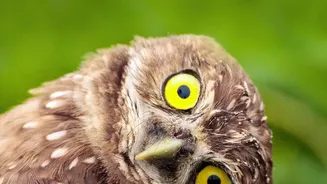
The first question is why an owl needs this ability at all. The answer lies in its eyes. Unlike humans, whose spherical eyes can move around in their sockets, owls have large, tube-shaped eyes. These 'eyetubes' are fixed in place by bony structures called
sclerotic rings. This anatomy provides them with exceptional binocular vision and depth perception, which is perfect for spotting prey from a distance in low light. But it comes at a cost: to look left or right, an owl can't simply glance over. It has to turn its entire head. This extreme rotation is not a party trick; it's a fundamental requirement for survival, allowing them to scan their environment for both predators and prey.
The Skeletal Secret
A human attempting a 270-degree head turn would face catastrophic injury, so how is an owl's skeleton different? For starters, owls have more hardware. While humans have just seven vertebrae in their necks, owls have 14. This doubles the number of joints and distributes the twist over a much longer, more flexible column. Furthermore, the holes in these vertebrae, called transverse foramina, through which major arteries pass, are about 10 times larger than the artery itself. This creates a protective, cushioned space. Instead of the artery being pinched or sheared during a sharp turn, it has plenty of room to move around within an air-cushioned channel.
Solving the Blood-Flow Riddle
Even with flexible bones, such an extreme twist should logically cut off blood supply to the brain. This is where the owl’s most ingenious adaptations come into play. A landmark study from Johns Hopkins University revealed several biological masterstrokes. Researchers found that owls have special blood-pooling systems. Arteries at the base of the head expand into contractile reservoirs, holding a ready supply of blood to keep the brain and eyes nourished even if flow from the neck is momentarily constricted. It’s like having a backup generator for your blood supply. Additionally, owls have tiny vessel connections between their carotid and vertebral arteries. These links, or anastomoses, create redundant pathways, ensuring that if one route for blood is blocked by a twist, another can take over, guaranteeing an uninterrupted flow to the brain.
A Question of Degrees
The 270-degree figure represents the maximum rotation possible from a forward-facing position. An owl can turn its head to look directly over its shoulder (180 degrees) and then keep going another 90 degrees until its bill is nearly lined up with the center of its back. They can do this in either direction, left or right. While they have a potential range of motion of 540 degrees if you count the full sweep from one extreme to the other, they rarely use this full capacity. Most often, an owl will turn its head about 180 degrees before swiveling back the other way. This incredible flexibility, born from evolutionary necessity, remains one of the most elegant and complex solutions in the animal kingdom, a perfect marriage of skeletal structure and vascular ingenuity.