


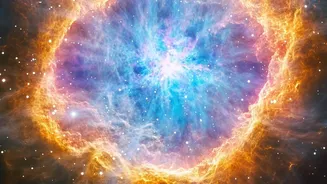
Is it a star or a planet? For some objects in the cosmos, the line is surprisingly blurry. New findings from a powerful NASA space telescope are revealing just how much 'failed stars' have in common with the gas giants in our own cosmic backyard.
A New Eye on the Cosmos
NASA's
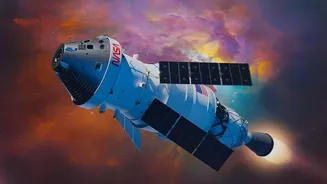
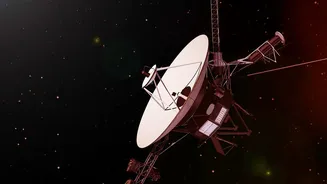
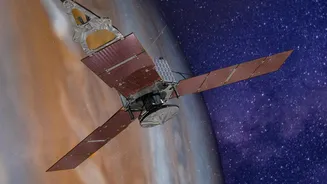
SPHEREx telescope, short for Spectro-Photometer for the History of the Universe, Epoch of Reionization, and Ices Explorer, is on a mission to map the entire sky in infrared light. Launched in March 2025, this powerful observatory creates a spectrum for everything it sees, measuring brightness across 102 different colours of light that are invisible to the human eye. This capability allows it to probe the chemical makeup and temperature of celestial objects in unprecedented detail. While SPHEREx has broad goals—like studying the origins of the universe and the formation of galaxies—it's proving especially adept at hunting for 'dark wanderers': brown dwarfs.
Cosmic In-Betweeners
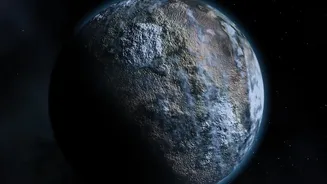
So, what exactly are brown dwarfs? First theorized in the 1960s and discovered in the 1990s, they are often called 'failed stars'. Like stars, they form from the gravitational collapse of a giant cloud of gas and dust. However, they never accumulate enough mass—the threshold is about 80 times the mass of Jupiter—to ignite the sustained hydrogen fusion that makes stars shine. Instead, they are left in a curious middle ground: more massive than planets but not quite stars. They drift through space alone, glowing dimly from leftover heat and, in some cases, the fusion of a heavier hydrogen isotope called deuterium. This makes them fascinating laboratories for understanding both star and planet formation.
Unexpected Atmospheric Twins
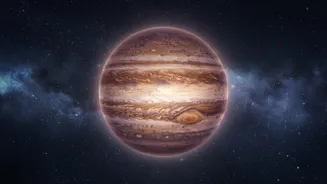
The latest SPHEREx survey has analyzed dozens of nearby brown dwarfs and found that their atmospheres are strikingly similar to those of gas giant planets. Researchers were surprised to find that these solitary worlds have chemically rich atmospheres, with clear spectral signatures of water, methane, carbon monoxide, and carbon dioxide. These are the same molecules found in the atmospheres of planets like Jupiter and Saturn. The finding suggests that the atmospheric processes on these two very different types of objects might follow similar rules, even though one is a lonely wanderer and the other is part of a solar system.
Weather on Wandering Worlds
The similarities go beyond just chemical composition. The data from SPHEREx suggests that brown dwarfs have complex, cloudy, and dynamic atmospheres, much like a gas giant. While some previous observations with other telescopes, like the James Webb Space Telescope, had suggested brown dwarf atmospheres could be chaotic, SPHEREx's ability to observe thousands of these objects is providing a much bigger picture. Scientists are finding that no two brown dwarfs are exactly alike, even at similar temperatures, suggesting a huge diversity in their atmospheric conditions. These findings are turning astronomers into 'accidental meteorologists', as they work to understand the weather on these exotic worlds.
Why This Blurry Line Matters
This research does more than just challenge our neat cosmic categories. Understanding the atmospheres of brown dwarfs provides a vital reference point for studying exoplanets—planets orbiting other stars. Because free-floating brown dwarfs aren't blinded by the glare of a parent star, they are much easier to study in detail. The atmospheric models developed for them can be applied to better understand the conditions on newly discovered gas giants far across the galaxy. The SPHEREx data has already revealed that current atmospheric models struggle to fully explain the complexity observed, pushing scientists to refine their theories about how planetary and substellar atmospheres form and evolve.