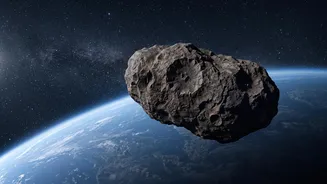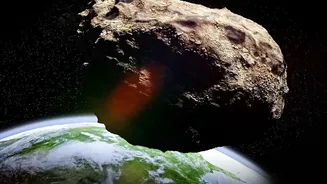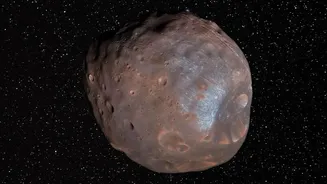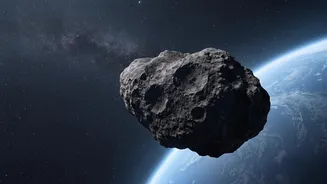

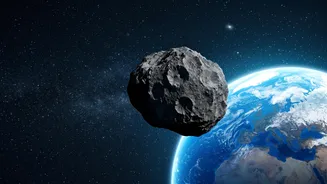
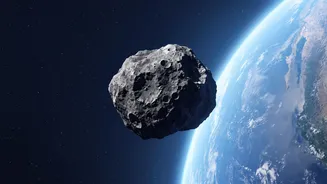
Earth has a temporary new companion. A small asteroid, dubbed 2026 QQ8, was recently captured by our planet's gravity, becoming a 'mini-moon'. But this cosmic visitor won't be staying for long, offering a fascinating glimpse into the dynamic dance of objects
in our solar system.
Meet Earth’s Newest Mini-Moon
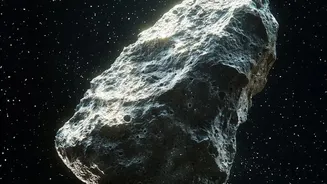
Our solar system can feel like a familiar, orderly place, but it's full of surprises. The latest is 2026 QQ8, a small space rock recently identified as Earth’s newest temporary satellite, or 'mini-moon'. Discovered in August 2026 by astronomer Krisztián Sárneczky, this object is tiny, with an estimated diameter between 1.4 and 3 meters. While our primary Moon has been a steadfast companion for billions of years, mini-moons are transient visitors. These small asteroids are occasionally captured by Earth's gravitational pull and can remain in orbit for months or even a few years before continuing on their own path around the sun. Don't expect to see 2026 QQ8 with the naked eye; its small size and distance—currently about 50% farther away than the Moon—make it visible only to powerful telescopes.
The Difference Between Mini-Moons and Quasi-Satellites
The terms 'mini-moon' and 'quasi-satellite' are often used interchangeably, but they describe different celestial relationships. A mini-moon, like 2026 QQ8, is an object that is temporarily captured by Earth's gravity and physically orbits our planet for a short time. These orbits are often unstable, and after a few loops, the object typically escapes back into its own solar orbit. In contrast, a quasi-satellite is not gravitationally bound to Earth. Instead, it orbits the sun on a path so similar to Earth's that it stays close to us for long periods, appearing to loop around our planet from our perspective. Famous examples of quasi-satellites include Kamoʻoalewa and 2023 FW13, which will remain our cosmic neighbors for centuries. These objects are in a 1:1 orbital resonance with Earth, meaning they take the same amount of time to circle the sun.
A Long, Looping Goodbye
The visit from 2026 QQ8 is fleeting. Astronomers predict it will remain in Earth's orbit only until December 2026 or January 2027. After that, the gravitational pulls of the Sun and other planets will guide it out of Earth's sphere of influence, and it will resume its journey as a sun-orbiting asteroid. This is a normal and expected fate for all mini-moons. Their orbits are inherently unstable, and they eventually drift away. However, this isn't necessarily a final farewell. Because 2026 QQ8's orbit around the sun is still very similar to Earth's, it will have future close approaches. Its next notable pass is predicted for 2058, though it will be much farther away, at about five times the Earth-Moon distance.
Why We Study These Tiny Visitors
Though small and temporary, mini-moons and quasi-satellites are scientifically valuable. They provide a unique opportunity to study asteroids up close without the immense cost and time of a deep-space mission. Many of these objects originate from the main asteroid belt between Mars and Jupiter, and their composition can tell us about the raw materials that formed our solar system over 4.5 billion years ago. Asteroids are generally made of rock, clay, silicates, and metals like iron and nickel. Some, known as carbonaceous or C-type asteroids, contain organic carbon and even water ice, offering clues to how life's building blocks may have been distributed. In some fascinating cases, like the quasi-satellite Kamoʻoalewa, the object's composition suggests it may actually be a fragment of our own Moon, blasted into space by an ancient impact.