

Saturn’s Golden Glow
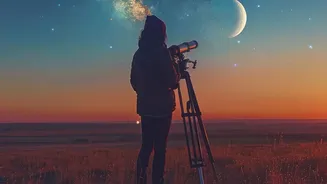
While Saturn officially reaches its annual opposition in early October, the weeks leading up to it in late August are a fantastic time to observe the ringed planet. During this period, it will be visible for much of the night, appearing as a bright, steady,
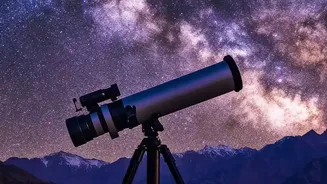
golden-hued 'star'. Look for it rising in the east around sunset and tracing a path across the sky throughout the night. On the evenings of August 29th and 30th, the Moon will be near Saturn, making it even easier to locate. While any pair of binoculars will help you appreciate its brightness, even a small telescope can begin to reveal its most famous feature: the rings. Following a period where they were edge-on and nearly invisible, the rings are now tilting back towards us, making for an increasingly rewarding view.
The Morning Planet Parade
For early risers, the pre-dawn sky in late August offers a beautiful lineup of planets. Look to the east about an hour before sunrise to catch Mars, which will be climbing higher above the horizon as the month progresses. Mars will be visibly bright and easy to spot with the naked eye. Though more challenging, you might also glimpse Mercury and Jupiter low on the eastern horizon. Their visibility can be tricky due to their proximity to the rising sun, so a clear, unobstructed view is essential. Saturn will also be part of this morning display, shining in the south before dawn.
The Fading Fires of the Perseids
The famous Perseid meteor shower reaches its peak around August 12-13. However, the shower remains active until the beginning of September. This means that even in the latter half of August, patient observers in dark locations still have a chance to spot a few lingering 'shooting stars'. The best time to look is after midnight, facing the northeast. While the rate of meteors will be much lower than at the peak, catching a stray, bright Perseid streak across the sky is a magical experience. For the best chance, get away from city lights, let your eyes adjust to the darkness for at least 20 minutes, and look up.
A Glimpse of the Milky Way’s Core
Late summer provides one of the last best chances of the year to see the majestic core of our own galaxy, the Milky Way. Between August and September, the ideal time to look is a couple of hours after sunset. From a location with truly dark skies, away from urban light pollution, the galactic core appears as a dense, glowing cloud of stars low in the southern sky, within the constellations Scorpius and Sagittarius. After a monsoon rain shower, the air is often washed clean of dust, leading to exceptionally clear skies that can make this sight even more spectacular. While challenging for city dwellers, those in rural areas or designated dark sky reserves like Hanle in Ladakh will have the most breathtaking view.
The Summer Triangle Overhead
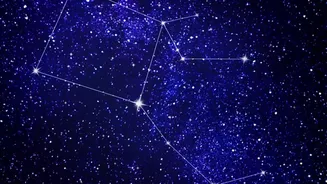
One of the most prominent and easily recognizable star patterns of the season is the Summer Triangle. This is not a constellation but an asterism, a simple shape formed by three of the brightest stars in the sky: Vega (in the constellation Lyra), Deneb (in Cygnus), and Altair (in Aquila). High overhead during August evenings, these three brilliant stars form a large, clear triangle. Because they are so bright, they can often be spotted even from suburban skies where fainter stars are washed out by light pollution. Finding the Summer Triangle is a great starting point for beginners to orient themselves before searching for dimmer constellations.