


Understanding Core Strength Beyond the Six-Pack
First, it's important to understand what the 'core' truly is. It isn't just the superficial 'six-pack' muscles (the rectus abdominis). In yoga, the core is seen as a complete system that wraps around your entire torso like a natural corset. This includes
the deep transverse abdominis, the obliques along your sides, the muscles of your lower back, your pelvic floor, and even your diaphragm. A strong, integrated core provides stability for your spine, improves posture, enhances balance, and helps make every movement feel more supported and effortless.
The Power of the Isometric Hold
The secret to building strength with gentle yoga lies in isometric contraction. This is when your muscles are engaged and under tension, but don't actually change length. Think about holding a pose for several breaths. That sustained effort is precisely what trains the deep, stabilizing muscles that quick, repetitive movements often miss. This method increases the muscle's time under tension, a key factor for building both strength and endurance. It trains your core to support you functionally, which is invaluable for long-term health and preventing issues like lower back pain.
Balancing Table Pose (Dandayamana Bharmanasana)
Also known as Bird-Dog Pose, this is a fantastic beginner-friendly movement for building stable core strength. Start on your hands and knees in a 'tabletop' position, with your shoulders stacked over your wrists and hips over your knees. On an inhalation, extend your right leg straight behind you and your left arm straight in front, keeping both parallel to the floor. The key is to keep your hips and shoulders square to the ground, resisting the urge to twist. Your abdominals and lower back muscles must work together to keep your spine steady. Hold for five breaths, then gently return to the start and switch sides.
Bridge Pose (Setu Bandhasana)
Bridge Pose is a gentle backbend that is excellent for strengthening the glutes and lower back, which are crucial posterior parts of your core. Lie on your back with your knees bent and feet flat on the floor, hip-width apart. Your arms should be resting alongside your body with palms down. On an exhale, press through your feet and lift your hips off the floor. Try to create a long, straight line from your shoulders to your knees. Avoid arching your back too much; instead, focus on engaging your glutes and hamstrings. Hold this position for 30 to 60 seconds, breathing steadily, before slowly rolling your spine back down to the floor.
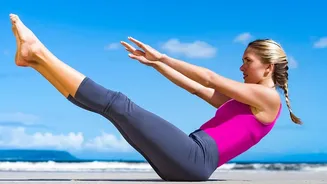
Modified Boat Pose (Navasana)
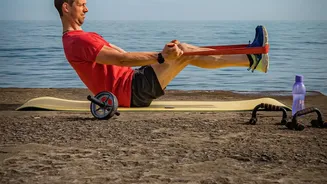
The full Boat Pose is a powerful core challenge, but this modified version is more accessible while still being highly effective. Start by sitting on the floor with your knees bent and feet flat. Place your hands on the mat behind you for support. Lean back slightly, keeping your chest lifted, and engage your abdominal muscles as you lift your lower legs until your shins are parallel to the floor. If this feels stable, you can challenge yourself by lifting your hands from the floor and extending your arms forward, parallel to the ground. The key is to keep your back straight and your core tight to maintain balance. Hold for five to eight breaths.
Chair Pose (Utkatasana)
Chair Pose is a full-body exercise that seriously engages the core to stabilize the spine. Stand tall with your feet together or hip-width apart. Inhale and raise your arms overhead. As you exhale, bend your knees and sink your hips down and back, as if you were sitting in an imaginary chair. Keep your weight in your heels and your chest lifted. Your core works constantly to support your lower back and keep your torso upright against the pull of gravity. For a gentler variation, you can practice with your back against a wall for support. Hold for 30 seconds, focusing on deep, even breaths.