

The Moon’s Hidden Treasure
The Moon may look bone-dry, but it holds a vital secret. For decades, scientists suspected water could exist in the darkest corners of the lunar poles. In 2008, data from India's Chandrayaan-1 spacecraft confirmed the presence of water ice. The key lies
in 'permanently shadowed regions' (PSRs) — deep craters at the lunar South Pole that sunlight has never touched. In these incredibly cold traps, temperatures plummet to levels colder than Pluto, preserving ice that likely arrived via comets and asteroids millions of years ago. This isn't just a scientific curiosity; for NASA, this ice represents the single most important resource for making long-term settlement on the Moon a reality. The entire concept is known as In-Situ Resource Utilization (ISRU), which simply means using what you can find locally instead of hauling it all from Earth at enormous cost.
A Robotic Prospector Named VIPER
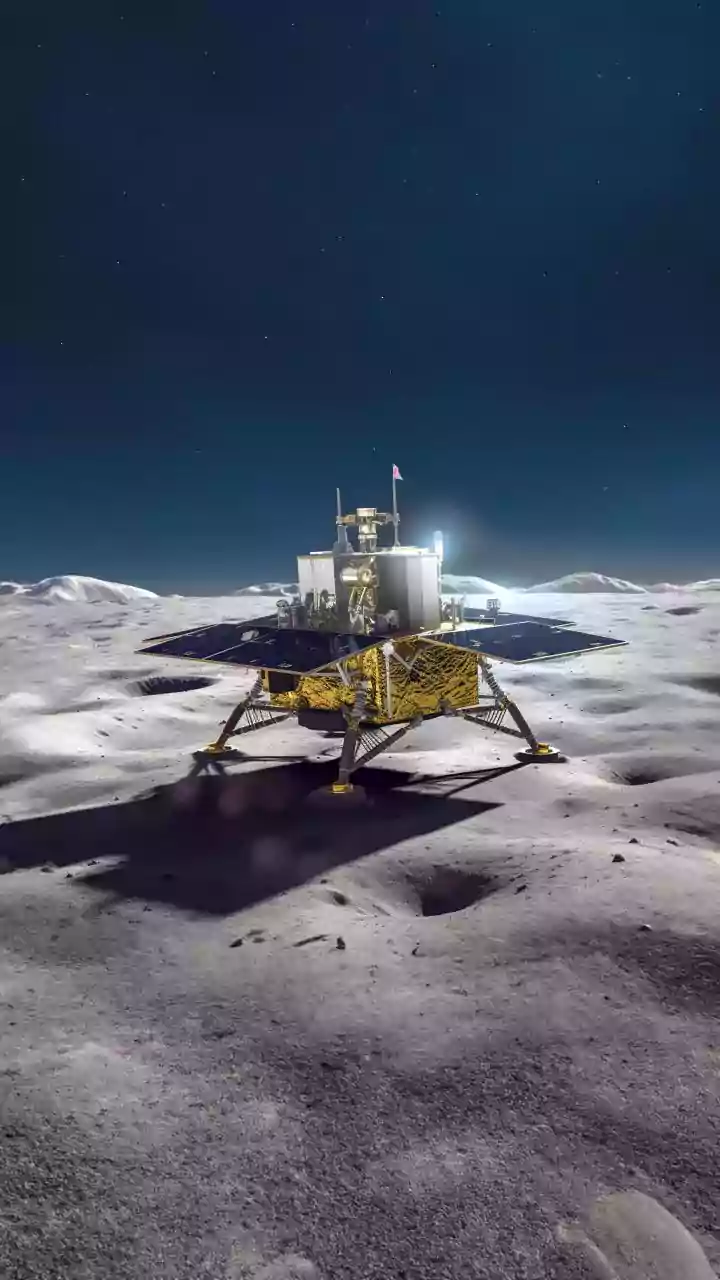
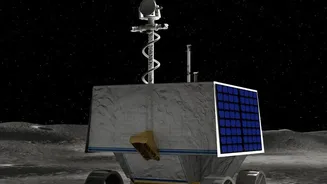
Before we can mine this ice, we need to know exactly where it is, how much there is, and how deep it goes. Enter NASA's VIPER (Volatiles Investigating Polar Exploration Rover). This golf-cart-sized robot is a prospector designed to map the lunar ice. Its mission is to drive into the treacherous, dark craters of the South Pole and drill into the soil. Equipped with a meter-long drill called TRIDENT and spectrometers, VIPER will analyze the soil on the spot to determine the concentration and state of the water ice. The data it collects will be used to create the first-ever resource maps of the Moon, guiding where future Artemis astronauts will land and set up their base. Though the VIPER project was briefly canceled due to cost overruns, it was revived with plans for a 2027 launch, highlighting its critical importance to NASA's long-term goals.
From Ice to Air, Water, and Rocket Fuel
So, why is this frozen water so valuable? Its uses are threefold and fundamental to survival. First, it can be melted and purified to provide drinking water for astronauts. Second, through a process called electrolysis, the water (H2O) can be split into its component elements: breathable oxygen for habitats and hydrogen. The oxygen is obviously essential for life support, but it also serves another critical purpose. Combined with the hydrogen, it creates a powerful rocket propellant. This means a lunar base could one day become a refueling station for missions deeper into space, like Mars. The ability to produce air, water, and fuel on-site drastically reduces the mass and cost of missions, transforming the economics of space exploration.
The Challenge of the Lunar Gold Rush
Harvesting lunar ice will be one of the most difficult engineering challenges humanity has ever undertaken. The environment is unimaginably harsh, with extreme temperature swings, abrasive lunar dust, and the vacuum of space. The ice isn't a clean, solid sheet but is mixed in with the lunar soil, known as regolith. Engineers are exploring various extraction methods, from robotic excavators that dig up the frozen soil and heat it in a contained processor, to using concentrated solar energy or microwaves to sublimate the ice directly from the ground, turning it into vapor that can be captured. These operations will demand immense power, likely from solar panels placed on sunlit crater rims or small nuclear reactors. Furthermore, the hardware itself must be incredibly robust to function in temperatures that can destroy conventional machinery.