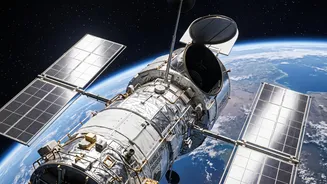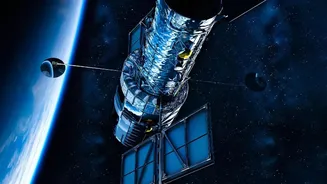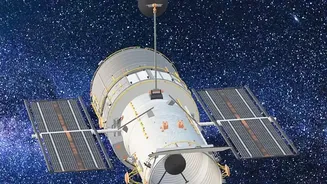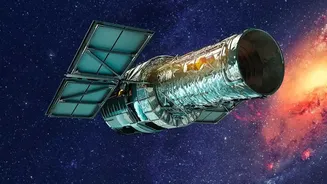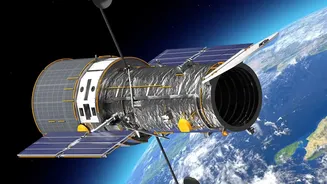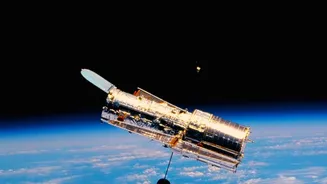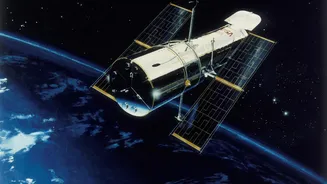



For over 35 years, the Hubble Space Telescope has been humanity's eye on the cosmos. But its orbit is slowly decaying, threatening a fiery end. Now, NASA is turning to the private sector for an unprecedented commercial rescue mission.
An Icon's Slow Descent
Since its launch
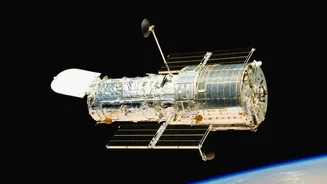
in 1990, the Hubble Space Telescope has operated flawlessly, making over 1.7 million observations and revolutionizing our understanding of the universe. However, it faces a slow but certain threat: orbital decay. Like all objects in low-Earth orbit, Hubble experiences minuscule friction from the upper atmosphere. This atmospheric drag has caused its altitude to drop from an initial 612 kilometers to below 500 kilometers today. Unlike modern satellites, Hubble has no onboard propulsion system to counteract this descent. Without intervention, NASA predicts the legendary observatory will re-enter Earth's atmosphere sometime between 2033 and 2034, where it would largely burn up.
A New Commercial Lifeline
In a significant shift in strategy, NASA has formally reached out to the burgeoning commercial space industry for help. In late October 2026, the agency issued a Request for Information (RFI), a formal call to private companies to propose ideas and outline their capabilities for a potential Hubble mission. This is not a contract but a market research exercise to see what's possible. The RFI asks for concepts on three main possibilities: boosting Hubble to a higher, more stable orbit to extend its life; servicing it with new components to enhance its capabilities; or performing a safe, controlled de-orbit at the end of its mission. It signals NASA's willingness to embrace innovative, cost-effective solutions from a rapidly evolving private sector.
Who Could Answer the Call?
The most prominent name linked to a potential Hubble mission is SpaceX, in partnership with the Polaris Program led by billionaire and current NASA Administrator Jared Isaacman. A 2022 study explored the feasibility of using a SpaceX Dragon capsule to visit and reboost the telescope. While NASA initially decided not to pursue that specific plan, Isaacman's new role and the new RFI have renewed interest. However, the field is open to others. The on-orbit servicing market is growing, with companies like Northrop Grumman's subsidiary SpaceLogistics, which has already performed life-extension missions, and Astroscale, which specializes in debris removal and satellite maintenance. The RFI invites any company with the technical know-how to submit their ideas before the November 30, 2026 deadline.
More Than Just a Boost
A successful mission would do more than just save Hubble; it would pioneer a new era of space stewardship. The primary goal would be to raise Hubble's orbit to at least 600 kilometers, which could add 15 to 20 years to its operational life. But the possibilities don't stop there. A servicing mission could potentially upgrade Hubble’s scientific instruments, similar to the five successful servicing missions conducted by Space Shuttle crews between 1993 and 2009. Even if the decision is to retire Hubble, a private mission could ensure it is done safely, preventing an uncontrolled re_entry and guiding its debris into a remote ocean location. This move represents a test case for how to sustainably manage valuable assets already in orbit.
A Race Against Time and Drag
With a re_entry date looming in the mid_2030s, the clock is ticking. NASA anticipates any servicing or reboost mission would need to take place by 2032 to be effective. The challenge is immense. A commercial provider would be responsible for the launch, the spacecraft, and the complex rendezvous and capture maneuvers, all without harming the priceless telescope. Previous proposals have highlighted risks, including the need for unproven extravehicular activities (EVAs) or docking with a telescope not designed for it. Despite the hurdles, the scientific and cultural value of Hubble is undeniable. As NASA Administrator Jared Isaacman stated, the agency owes it to taxpayers and the scientific community to explore every reasonable opportunity to keep it delivering science for as long as possible.