






From Fluffy Snow to Solid Ice
Every glacier begins its life as individual snowflakes. When fresh snow falls, it is light and fluffy, full of air pockets. Its density is very low, sometimes less than 100 kilograms per cubic metre. As more snow piles on top, the weight begins to compress
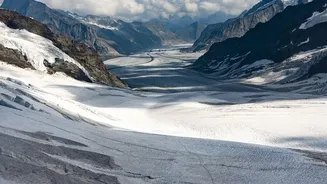
the layers below. The delicate snowflakes are crushed, their intricate arms breaking down, and they become granular, rounded crystals. This transitional material, which has survived at least one melt season but has not yet become ice, is known as 'firn'. Firn is much denser than snow, but it still contains interconnected air passages. This entire process is called firnification. The journey from snow to firn and finally to solid glacial ice is a slow transformation driven by pressure and time.
The Squeeze of Deep Time
As a layer of firn gets buried deeper and deeper, often under hundreds of metres of subsequent snowfall, the pressure becomes immense. This pressure forces the ice crystals to grow and rearranges them, squeezing out the remaining air. The interconnected air channels within the firn are eventually pinched off, trapping air as isolated bubbles within the solid ice. This transformation is complete when the density reaches about 830 kilograms per cubic metre. Below this point, which can be anywhere from 50 to 100 metres deep depending on conditions like temperature and accumulation rate, it is officially considered glacial ice. The density continues to increase slightly with depth due to the immense pressure compressing the ice crystals and the trapped air bubbles, approaching the density of pure ice, which is about 917 kilograms per cubic metre.
Reading the Layers for Snowfall Clues
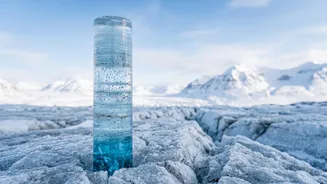
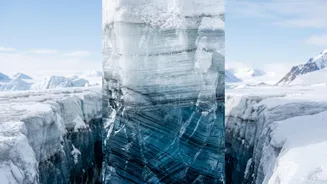
Scientists drill and extract long cylinders of ice, called ice cores, which provide a vertical timeline of past climate. The thickness of the annual layers in these cores can offer direct clues about past snowfall. A thicker layer generally suggests a year with higher snowfall, while a thinner layer indicates less precipitation. However, scientists must also account for how the ice has been compressed and how it flows. The density provides the missing piece of the puzzle. By modelling how the firn compacts into ice, a process influenced by temperature and the weight of overlying snow, researchers can more accurately translate layer thickness into annual snowfall rates from thousands of years ago. Essentially, understanding the densification process allows them to 'decompress' the ice layers in their models to figure out their original thickness.
Bubbles of Ancient Atmosphere
The tiny bubbles of air trapped in the ice are invaluable. They are miniature time capsules of Earth’s past atmosphere. By analysing the gases within these bubbles, scientists can directly measure the concentration of greenhouse gases like carbon dioxide and methane from hundreds of thousands of years ago. This data, when paired with temperature information derived from water isotopes in the ice itself, shows a clear link between atmospheric composition and global climate shifts. The process of how these bubbles get trapped is directly linked to densification. The rate of snowfall can affect how quickly the firn pores close off, influencing the age of the trapped air relative to the surrounding ice. Therefore, a precise model of ice density helps correctly date both the ice and the ancient air it holds.
Why This Matters for India's Future
This research isn't just about understanding the distant past; it has critical implications for the future, especially for India. The Himalayan glaciers are often called the 'Water Towers of Asia' as they feed major rivers like the Ganges, Indus, and Brahmaputra, which are lifelines for millions. By studying ice cores from these glaciers, scientists can reconstruct past monsoon intensity and snowfall patterns. Understanding how snowfall rates have changed over centuries helps climate modellers build more accurate predictions about the future stability of these glaciers in a warming world. This knowledge is crucial for managing water resources, anticipating changes in river flow, and preparing for the long-term impacts of climate change in the region.