


The Logistics of Life Support
For any long-term settlement, whether on Earth or in space, a steady supply of essentials is non-negotiable. For a future Moon base, the most critical resource is oxygen. Astronauts need it for life support, and rockets need it as an oxidiser for propellant.
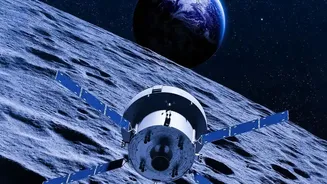
The problem is that launching anything from Earth is incredibly expensive. Every kilogram of supplies must be blasted out of our planet's gravity well, costing thousands of dollars. Packing enough oxygen for a multi-person crew to live and work for months, let alone years, would require an unsustainable number of costly and complex resupply missions. This logistical challenge has been a major barrier to planning a truly sustainable lunar outpost, a key goal of NASA's Artemis program.
An Ocean of Oxygen Trapped in Dust
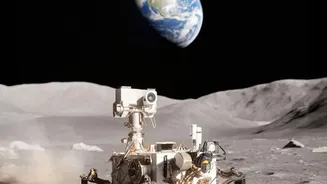
The solution, it turns out, is hiding in plain sight. The Moon may not have an atmosphere, but its surface is covered in a layer of fine dust and crushed rock called regolith. This material is surprisingly rich in oxygen. By weight, lunar regolith is composed of about 45% oxygen. The catch is that this oxygen is not freely available; it's chemically bonded with elements like silicon, aluminium, and iron to form oxide minerals. The Moon is essentially covered in rusted metal and rock. The challenge for NASA scientists is not finding the oxygen, but breaking those strong chemical bonds to release it in a breathable, gaseous form. This concept of using local materials is known as in-situ resource utilization, or ISRU, and it's seen as essential for deep space exploration.
Cooking the Rocks to Breathe
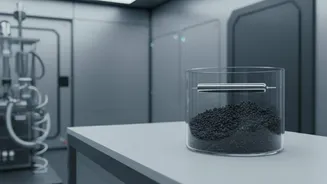
So, how do you get oxygen out of a rock? The leading method NASA is developing is a process called molten oxide electrolysis. In simple terms, you melt the moon dust. Future lunar machinery would scoop up regolith and heat it to extreme temperatures, around 1,800 degrees Celsius, inside a specialised reactor. Once the regolith is molten, an electrical current is passed through it. This acts like a chemical crowbar, breaking the oxygen away from the metallic oxides. The liberated oxygen bubbles up and can be collected and stored. A recent demonstration project called the Carbothermal Reduction Demonstration (CaRD) successfully used a solar concentrator to simulate sunlight for heating the material, proving the concept could work using the Moon's own resources. The process has a very useful byproduct: the remaining molten material is a mix of metal alloys, which could potentially be used for manufacturing or construction on the lunar surface.
From the Lab to the Lunar Surface
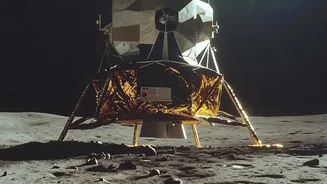
This technology isn't just a theory. NASA and its commercial partners, like Sierra Space, have been successfully testing prototypes in vacuum chambers on Earth, simulating the airless lunar environment. Teams at NASA's Johnson Space Center and Kennedy Space Center have advanced different aspects of the technology, from the reactors to the methods of heating them. The next step is to prove the technology works on the Moon itself. The agency plans to send a demonstration payload, part of a mission called Lunar Infrastructure Foundational Technologies (LIFT-1), to the lunar surface to test the oxygen extraction process in the real environment. These demonstrations are critical steps in maturing the technology from an experiment into a reliable, automated system that future Artemis astronauts can depend on.
A Gas Station for the Solar System
The ability to generate oxygen on the Moon has implications that extend far beyond life support. The vast majority of a rocket's mass is not fuel, but the oxidiser needed to burn that fuel. Producing thousands of kilograms of liquid oxygen on the Moon could effectively turn it into a refuelling station for spacecraft. Instead of launching a mission to Mars from Earth with all the propellant needed for a round trip, a rocket could launch to the Moon, top up its oxygen tanks, and then depart for Mars. This would dramatically reduce the mass and cost of deep space missions, making the entire solar system more accessible. Creating a self-sustaining infrastructure, starting with the most basic element of air, is the first real step toward making humanity a multi-planetary species.