






The Crowded Sky Above
Low Earth Orbit (LEO), the orbital highway stretching up to 2,000 kilometres above us, is dangerously congested. It's not just packed with the thousands of active satellites that provide us with everything from GPS navigation and weather forecasting to internet
connectivity. It's also littered with 'space junk': defunct satellites, spent rocket stages, and millions of fragments from past collisions and explosions. According to NASA, there are over 34,000 objects larger than 10 cm being tracked, but the real number is far higher when you include smaller, untraceable pieces. An estimated 128 million fragments smaller than a centimetre are zipping around at speeds up to 28,000 km/h. At that velocity, even a fleck of paint can strike with the force of a bullet, capable of disabling a multi-million dollar satellite or threatening the International Space Station. This growing cloud of debris poses a direct threat to our space infrastructure and raises the terrifying prospect of the Kessler Syndrome—a chain reaction where collisions create more debris, leading to more collisions, potentially rendering parts of orbit unusable.
Solution 1: Harpoons and Nets
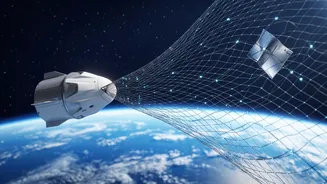
To prevent this orbital catastrophe, space agencies and private companies are developing a range of 'Active Debris Removal' (ADR) technologies that sound like they're straight out of science fiction. One of the most tested concepts is the harpoon. In a mission called RemoveDEBRIS, a satellite successfully fired a harpoon at 20 meters per second to pierce a target panel, demonstrating that a chaser spacecraft could physically capture a piece of rogue debris. The idea is for a 'space tug' to fire a tethered harpoon into a larger piece of junk, like a dead satellite, and then drag it down into Earth's atmosphere to burn up safely. Airbus has been a key developer of this technology. A similar low-tech, high-impact approach involves using a giant net. The same RemoveDEBRIS mission also successfully demonstrated casting a net to capture a simulated piece of debris. The European Space Agency (ESA) has explored this concept for its missions, appreciating that a net can successfully capture targets with irregular shapes or those that are tumbling unpredictably.
Solution 2: Magnets and Lasers
Not all debris is easy to grab. That's where magnets come in. Japanese company Astroscale has pioneered a magnetic docking system. Its ELSA-d mission successfully demonstrated a servicer satellite repeatedly capturing and releasing a client satellite fitted with a ferromagnetic plate. The business model is for future satellites to be built with these docking plates as standard, making it simple for an Astroscale 'tow truck' to latch on at the end of the satellite's life and guide it to a fiery atmospheric reentry. Other concepts involve using powerful magnetic fields to induce electrical currents (eddy currents) in non-magnetic but conductive debris, like objects made of aluminium. This would allow a chaser to slow a tumbling object's spin without physical contact, making it safer to capture. Another non-contact method involves lasers. Instead of blowing debris up, these lasers would work by vaporising a tiny part of an object's surface in a process called laser ablation. This creates a small plume of plasma that acts like a micro-thruster, gently nudging the object into a different, less hazardous orbit or pushing it towards atmospheric burn-up. This method could be effective for debris of almost any size.
The Business of Cleaning Up
Cleaning up space is no longer just a scientific exercise; it's a rapidly growing commercial market. The market for space debris removal is projected to grow exponentially, reaching an estimated value of $0.4 billion by 2028. This growth is driven by the sheer number of new satellites being launched, especially mega-constellations for global internet services. Companies like Swiss startup ClearSpace are leading the charge. Commissioned by ESA for the ClearSpace-1 mission, the company is developing a four-armed robotic 'claw' to capture and deorbit a specific piece of space junk, with a launch planned for 2028. Japanese firm Astroscale is already a major player, securing contracts with space agencies in Japan, the US, and the UK. These pioneers are creating a new service-based industry for orbit, offering everything from debris removal and satellite life extension to in-orbit inspection. Governments are also getting involved, with acts like the US ORBITS Act directing NASA to fund commercial partnerships to tackle the problem, signalling that orbital sustainability is now a critical part of space infrastructure.