





What Is a Planetary Alignment?
First, let's clear up a common misconception. A planetary alignment isn't like a scene from a sci-fi movie with planets forming a perfectly straight line in space. In reality, it's all about perspective. From our vantage point on Earth, the other planets in our solar
system appear to move across a narrow band in the sky called the ecliptic. An 'alignment' or 'conjunction' occurs when two or more planets appear very close to each other in this band. They are still millions of kilometres apart, but from our earthly view, they form a stunning, temporary gathering in the same small patch of the heavens.
Meet the Celestial Trio
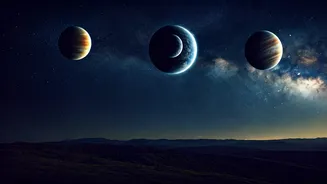
The stars of this show are three of the most captivating planets you can see without a telescope: Jupiter, Mars, and Saturn. Jupiter, the king of the planets, will be the brightest of the three, shining with a brilliant, steady white light. You can’t miss it. Look for Mars, the famous Red Planet, which will appear as a distinct, rust-coloured point of light. Its reddish hue becomes more obvious the longer you look. Finally, there’s Saturn. While not as bright as Jupiter, the ringed giant will be clearly visible as a steady, yellowish-white star. Seeing these three worlds hanging together in the twilight sky is a truly special sight.
When and Where to Look From India
Timing and location are everything for successful stargazing. This particular alignment will be visible in the evening sky for the next several days. The best time to look is approximately 45 to 90 minutes after sunset. As the sky darkens from blue to deep indigo, the planets will pop into view. You'll need a clear view of the western horizon, as that's where the trio will be located. They will appear as a tight-ish cluster or a rough line descending towards the horizon. As the days pass, their positions relative to each other will shift slightly, a beautiful and visible demonstration of the solar system in motion.
No Telescope? No Problem.
One of the best things about this celestial event is its accessibility. You do not need an expensive telescope or fancy equipment to enjoy it. Jupiter, Mars, and Saturn are all bright enough to be easily seen with the naked eye, even from moderately light-polluted suburban areas. Of course, if you have a pair of binoculars, now is the time to dust them off. Binoculars will not only make the planets appear brighter but may also give you a glimpse of Jupiter's four largest moons, which look like tiny pinpricks of light flanking the giant planet. It's an incredible bonus view that makes the experience even more rewarding.
Why This Moment Is So Rare
So, will this alignment really 'disappear forever'? Not exactly, but the headline captures a kernel of truth. While planets group together in various combinations fairly often, a conjunction of these three specific bright planets in the convenient evening sky is not a common occurrence. Each planet orbits the sun at a different speed—Earth takes 365 days, Mars takes 687 days, Jupiter about 12 years, and Saturn nearly 30 years. For their orbital paths to make them appear close together from our perspective is a matter of cosmic geometry. This particular configuration won't be seen again for many decades, making it a genuinely rare spectacle worth witnessing.
Tips for a Perfect Stargazing Session
To make the most of this event, find a spot with as little artificial light as possible. A park, a terrace, or even a balcony facing the right direction will work, as long as you can get away from direct glare. Give your eyes at least 15 minutes to adjust to the darkness; this will help you see more detail. You can also use a stargazing app on your phone (like Stellarium or SkyView) to help you identify the planets and surrounding constellations. Just be sure to switch the app to its red-light 'night mode' to preserve your night vision. Most importantly, share the moment. Bring your family or friends along for an unforgettable evening under the stars.