






The Foundation: Full-Body Compound Movements
Efficiency in fitness starts with choosing the right exercises. Instead of isolating small muscles, focus on compound movements that work multiple muscle groups at once. This gives you the most bang for your buck in the shortest amount of time. A balanced
routine should include movements that push, pull, and work your legs and core. Key exercises include push-ups for chest, shoulders, and triceps; squats and lunges for your entire lower body and core; and planks to build stability through your midsection. These movements are fundamentals for a reason: they are highly effective and build functional strength that you use in everyday life.
Mastering the Form for Maximum Results
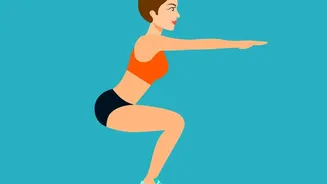
To get the most out of each repetition and, more importantly, to avoid injury, proper form is non-negotiable. For a squat, ensure your feet are shoulder-width apart, keep your chest up, and lower your hips as if sitting in a chair, making sure your knees track over your feet but not past your toes. With push-ups, your body should form a straight line from your head to your heels. Lower your body until your chest is close to the floor before pushing back up. For planks, align your elbows directly under your shoulders, keep your back flat, and engage your core by drawing your navel towards your spine to prevent your hips from sagging. Focusing on controlled movements is more effective than rushing through many sloppy reps.
Structure for Efficiency: The Circuit Method
To maximize your time, structure your workout as a circuit. This involves performing a series of exercises one after another with minimal rest in between. Moving quickly from one exercise to the next keeps your heart rate elevated, combining both strength and cardiovascular training into one session. For example, you can perform a set of squats, followed immediately by push-ups, then lunges, and finally a plank. After completing one full circuit of all exercises, you can rest for 60 to 90 seconds before starting the next round. Aiming for two to three rounds of a 10-exercise circuit is a great starting point for a workout that takes less than 30 minutes.
Keep Progressing: How to Make It Harder
As you get stronger, your body adapts. To continue seeing results, you need to apply the principle of progressive overload, which simply means making your workouts more challenging over time. With bodyweight training, you can't just add more weight to a barbell, but there are many other effective methods. You can increase the number of repetitions or add an extra set. Another way is to slow down the movement, especially the lowering (eccentric) phase, which increases the time your muscles are under tension. You can also decrease your rest time between circuits to increase the intensity. Finally, you can progress to more difficult variations of an exercise, like elevating your feet for push-ups or trying single-leg squats.
A Sample 20-Minute Efficient Bodyweight Circuit
Here is a simple but effective full-body workout you can do at home. Perform each exercise for 45 seconds, followed by 15 seconds of rest before moving to the next one. After completing all five exercises, rest for one minute. Repeat the entire circuit three times. Always start with a light warm-up like jogging in place or arm circles. 1. Bodyweight Squats: Focus on depth and keeping your chest up. 2. Push-Ups: If a full push-up is too hard, start with your knees on the ground or perform them on an incline against a table. 3. Alternating Lunges: Step forward into a lunge, alternating legs with each rep. Keep your torso upright. 4. Plank: Hold a steady position, ensuring your body is in a straight line. 5. Glute Bridges: Lie on your back with knees bent, and lift your hips toward the ceiling, squeezing your glutes at the top.