




A Cosmic Fireworks Display
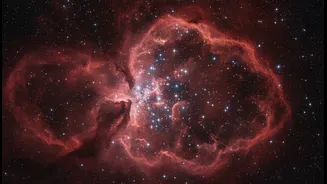
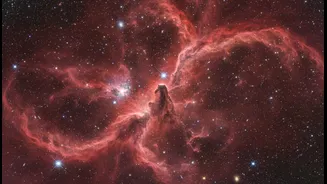
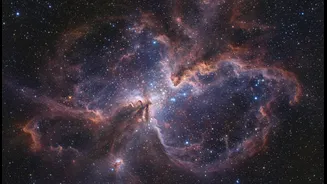
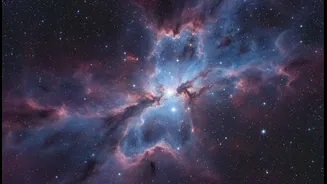
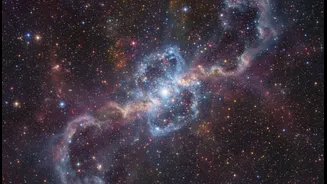
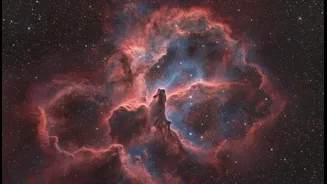
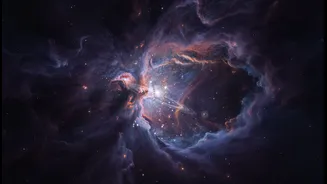
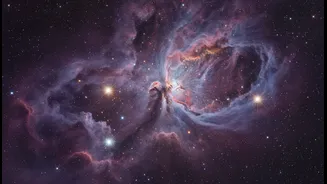
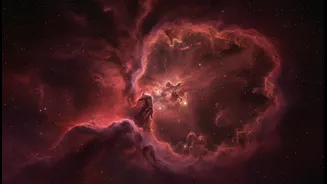
The latest subject of Hubble’s gaze is a region known as LH 95, located in the Large Magellanic Cloud, a small dwarf galaxy that orbits our own Milky Way. The image reveals a breathtaking scene: brilliant young blue and white stars sparkling against a backdrop
of glowing, crimson-colored gas and dark lanes of cosmic dust. This spectacular view, which NASA has compared to fireworks shining through smoke, is more than just a pretty picture. The nebula’s vivid red glow is a telltale sign of active star formation, caused by a specific wavelength of light called hydrogen-alpha, which is emitted when young, energetic stars heat the surrounding hydrogen gas. By capturing this light, Hubble allows astronomers to pinpoint the very youngest stars taking shape within the cosmic cloud.
Inside a Stellar Nursery
Star-forming regions like LH 95 are essentially cosmic nurseries. They begin as immense, cold clouds of gas and dust that drift through interstellar space. Gravity causes parts of these clouds to clump together and collapse inward. As the material gets denser, it heats up, forming a hot, dense core known as a protostar—a baby star. For millions of years, this protostar continues to pull in gas and dust from a surrounding disk, a process known as accretion. Once the core becomes hot and dense enough, nuclear fusion ignites, and the protostar transforms into a full-fledged star, releasing enormous amounts of energy that push back against gravity and stabilize it.
The 'Click' in Understanding
So, what's the new discovery that 'clicked' for scientists? The detailed observations of LH 95, which is home to about 2,500 developing stars, have provided a crucial clarification on the timeline of star birth. Astronomers had long theorized that a young star's accretion rate—the speed at which it gathers mass—slows down as it gets older. The new Hubble data confirms this. But more importantly, the research showed that this growth phase can last for several million years, which is longer than some previous models had suggested. This extended growth stage helps explain how stars build up their final mass and how the planetary disks around them have time to evolve before being blown away.
Multiple Generations, One Home
Another fascinating insight from the study of LH 95 is that star formation doesn't happen all at once in a single burst. The region contains multiple generations of stars living side by side. For instance, while most stars in the area are estimated to be around 4 million years old, the most massive star in the image—a behemoth 60 to 70 times the mass of our Sun—appears to be only about a million years old. This generational diversity shows that these stellar nurseries are dynamic, long-lived environments. The most massive and powerful blue stars sculpt the nebula with intense radiation and powerful stellar winds, creating the beautiful and complex structures Hubble sees today.