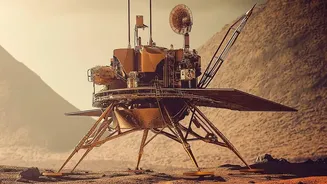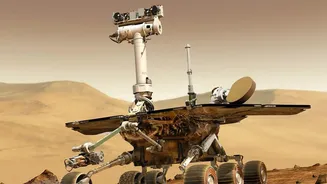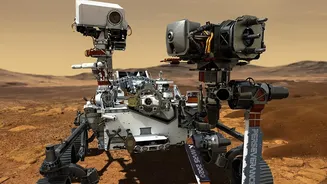





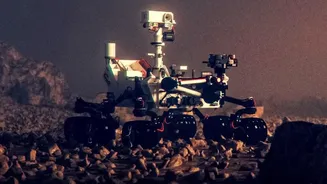

For decades, robots have been our tireless pioneers on Mars, sending back invaluable data. But as we dream of setting foot on the red planet, a crucial question arises: are these machines enough? The next giant leap may depend on human hands and minds.
The Indispensable Robotic Vanguards
It is impossible to overstate the achievements of robotic explorers. Machines like the Spirit, Opportunity, Curiosity, and Perseverance rovers have been the backbone of Martian exploration, operating for years in an environment hostile to human life. They don't need food, water, or return tickets, making them a cost-effective solution for initial reconnaissance. A robotic mission might cost under $3 billion, whereas a crewed mission could run into the hundreds of billions. These robots work 24/7, withstanding extreme temperatures and radiation while performing precise tasks like drilling and analysing soil. They are our eyes, ears, and hands on a world millions of miles away, laying the essential groundwork for every future step we plan to take.
The Dexterity Deficit
For all their precision, today's robots face a significant 'dexterity deficit'. A rover's robotic arm, while a marvel of engineering, pales in comparison to the human hand. Simple actions for a human—cracking open a specific rock, sifting through a delicate soil sample, or using a tool in an unplanned way—are monumental challenges for a robot that relies on pre-programmed instructions. An astronaut with a shovel could accomplish in minutes what it took the InSight lander's probe nearly two years to attempt. This limitation isn't a failure of design but a fundamental difference. While a robot can be programmed for specific tasks, it lacks the intuitive, adaptable physical grace of a human explorer who can repurpose their body and tools on the fly.
The Irreplaceable Judgement Gap
Beyond physical dexterity lies the even more critical gap in judgment. Robotic missions are constrained by communication delays that can take up to 20 minutes each way. This means every action must be meticulously planned, and there's no room for real-time, on-the-spot decision-making. A human geologist on Mars can use their experience and intuition to spot something scientifically interesting that a rover's algorithm might miss. They can react instantly to an unexpected discovery or a sudden problem, applying creative solutions that AI is not yet capable of. This ability to assess a complex, evolving situation and make an informed judgment call is perhaps the single most compelling argument for putting human boots on the Martian ground.
Efficiency, Speed, and Inspiration
When humans finally arrive on Mars, the pace of discovery is expected to accelerate dramatically. A human explorer can walk faster than a rover crawls and navigate tricky terrain that would be impassable for a wheeled vehicle. A team of astronauts could potentially conduct years' worth of robotic geological surveying in a matter of days. They can service and repair equipment, adapt to changing mission goals, and apply a level of versatility that a single-purpose machine cannot match. Furthermore, the human element provides an unparalleled source of inspiration. While rover landings are celebrated, the image of an astronaut planting a flag on another world carries a profound cultural weight that motivates future generations and galvanises public support for the grand endeavour of exploration.