




Meet India's First Space-Faring Humanoid
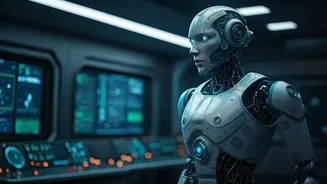
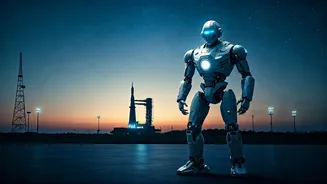
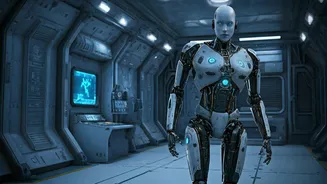
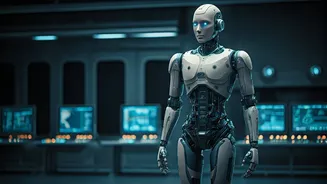
Vyommitra, a name derived from the Sanskrit words 'Vyoma' (Space) and 'Mitra' (Friend), is a sophisticated humanoid robot developed by the Indian Space Research Organisation (ISRO). Unveiled in early 2020, she is designed to be a crucial precursor to India’s
first crewed space mission, Gaganyaan. Visually, Vyommitra is a 'half-humanoid', meaning she has a torso, head, and arms, but no legs, as they are not needed for her role inside the crew module. Her purpose is singular and critical: to fly on the uncrewed test missions of the Gaganyaan spacecraft to simulate human presence and test all systems before any Indian astronaut takes that historic flight.
More Than Just a Test Dummy
Calling Vyommitra a 'dummy' would be a massive understatement. She is an AI-enabled robot capable of performing a wide array of tasks. She can operate switch panels, monitor the environment inside the crew module, and read displays. She is also equipped to communicate with mission control, able to speak both Hindi and English, recognize astronauts, and respond to queries. Her systems allow her to simulate human functions and interact with the spacecraft's life support systems. This includes monitoring cabin pressure, temperature, and other parameters, and sending alerts if anything goes awry. Essentially, she acts as a robotic crew member, providing invaluable data on how the spacecraft performs with a 'human' on board.
Why Send a Robot First?
The primary reason for sending Vyommitra into orbit is astronaut safety. The Gaganyaan mission aims to send a crew of astronauts to an orbit of 400 kilometers and bring them back safely to Earth. Before risking human lives, ISRO needs to be certain that every system on the spacecraft works perfectly in the harsh environment of space. Vyommitra’s missions will serve as the ultimate dress rehearsal. She will experience the intense vibrations and shocks during launch and re-entry, allowing engineers to understand the stresses on the human body. Her ability to operate systems and provide real-time feedback will validate the crew module's design and life support systems, ensuring the environment is perfectly safe for future astronauts, who are referred to as 'Gaganyatris' or 'Vyomanauts'.
Her Role in the Gaganyaan Mission
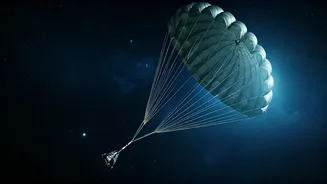
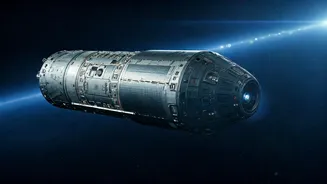
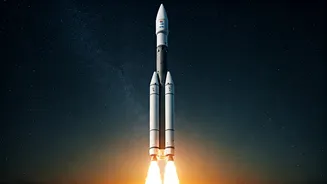
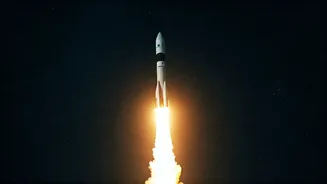
The Gaganyaan program is a multi-stage endeavor. It includes a series of uncrewed test flights before the final crewed mission. Vyommitra is scheduled to be on board the very first uncrewed flight, designated G1, which is targeted for launch in the second half of 2026. These uncrewed missions are designed to test the performance of the human-rated LVM3 launch vehicle, the orbital module's systems, and the crew escape and recovery operations. By collecting data on how the spacecraft's systems respond, Vyommitra's flight will help ISRO fine-tune everything for the subsequent flights. Following at least two successful uncrewed missions, ISRO plans to launch the first crewed Gaganyaan mission, which is now anticipated in 2027. This will make India only the fourth country in the world—after Russia, the United States, and China—to have an independent capability to send humans to space.