
Why Turn Our Gaze to Venus?
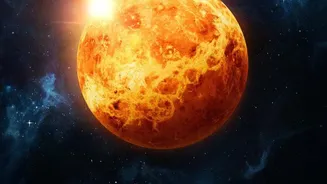
For decades, Mars has captured our imagination, but Venus holds equally compelling, and perhaps more cautionary, tales. Scientists believe that Venus may have once been similar to Earth, possibly with liquid water oceans. Today, however, its surface temperature
is hot enough to melt lead, and its atmosphere is over 90 times denser than Earth's, composed mostly of carbon dioxide with thick clouds of sulfuric acid. This dramatic transformation is the result of a runaway greenhouse effect—a scenario that provides a crucial, if extreme, case study for understanding planetary climate dynamics and the potential long-term evolution of Earth’s own climate. By studying Venus, we can gain invaluable insights into what makes a planet habitable and what can irrevocably change its destiny.
Shukrayaan-1: India’s Interplanetary Leap
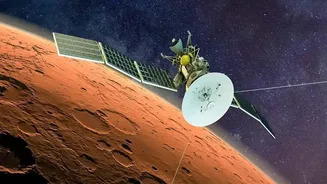
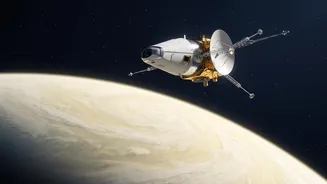
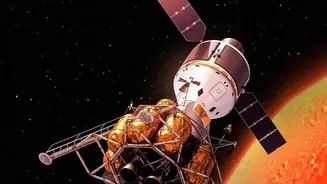
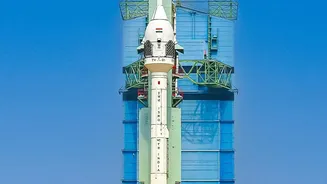
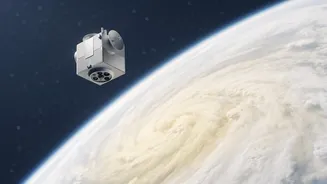
Following the monumental successes of Chandrayaan (Moon) and Mangalyaan (Mars), the Venus Orbiter Mission, nicknamed Shukrayaan-1, marks ISRO’s next great interplanetary challenge. Scheduled for a potential launch in March 2028, the mission involves placing a sophisticated orbiter around Venus to conduct a comprehensive study of the planet. The spacecraft will carry a suite of approximately 19 scientific instruments, a combination of Indian-made and internationally collaborative payloads, weighing around 100 kg. This mission positions India within an elite club of space agencies that have explored Venus, underscoring the nation's growing capabilities in deep space exploration.
The Power of Radar: Piercing the Veil
The single greatest obstacle to studying Venus has always been its impenetrable cloud cover. This is where Shukrayaan's key instrument, a high-resolution Synthetic Aperture Radar (SAR), comes into play. Unlike optical cameras that require light, radar can effectively 'see' through the thick atmosphere, day or night. The SAR will map the Venusian surface with a resolution far exceeding that of NASA’s Magellan mission in the 1990s. Its objectives are to identify active volcanic hotspots, lava flows, and other geological features that remain hidden from view. Additionally, a ground-penetrating radar will probe beneath the surface, a world-first for Venus, to investigate its stratigraphy—the layers of rock that hold the planet's geological history.
Decoding the Mysterious Clouds
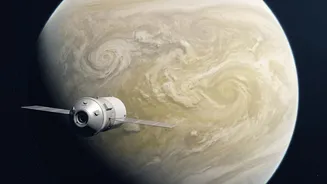
While the radar focuses on the surface, other instruments will target the headline-grabbing 'cloud formations and chemistry'. The mission aims to study the structure, composition, and dynamics of Venus's thick atmosphere. Scientists are particularly interested in the mysterious 'super-rotation,' where the atmosphere circles the planet in just a few Earth days, far faster than the planet itself rotates. Instruments will analyze the chemical makeup of the sulfuric acid clouds and how they interact with sunlight. Understanding these atmospheric processes is crucial for piecing together the puzzle of Venus's extreme climate and its stark divergence from Earth.
A Global Quest for Knowledge
Shukrayaan-1 is not just a national project but a collaborative international effort. Payloads and expertise from Russia, Sweden, and Germany will be part of the mission. This global cooperation highlights a renewed worldwide interest in Venus, with NASA and the European Space Agency (ESA) also planning their own missions like VERITAS, DAVINCI+, and EnVision in the coming decade. Together, these missions will provide a comprehensive and multi-faceted view of Venus, from its deep subsurface to the top of its atmosphere. The data gathered will collectively help scientists model the evolution of Earth-like planets, both in our solar system and beyond.