





The Monsoon Problem
For a nation that gets around 300 sunny days a year, solar power is a logical cornerstone of its energy strategy. Conventional photovoltaic (PV) panels, typically made from silicon, are excellent at converting direct sunlight into electricity. However,
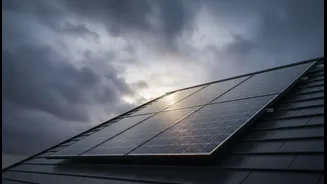
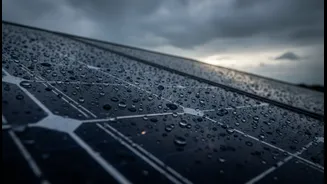
their efficiency plummets during the monsoon. Heavy cloud cover can reduce a panel's output to just 10-25% of its peak capacity. This intermittency creates a significant challenge for grid stability and the financial viability of large-scale solar projects, which rely on predictable energy generation to deliver returns on their massive initial investment. For several months each year, a key part of India's green energy infrastructure operates well below its potential, forcing a continued reliance on fossil fuels to meet demand.
Solution 1: Better Panels for Cloudy Days
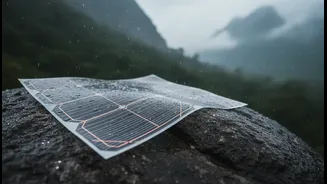
The first major breakthrough comes from a class of materials known as perovskites. Perovskite solar cells (PeSCs) are a new type of photovoltaic technology that is incredibly efficient at capturing energy from ambient and low-light sources. Unlike silicon, which is optimised for direct, bright sunlight, perovskites can absorb a wider spectrum of light. This means they perform significantly better on overcast and cloudy days. Research has shown perovskite cells can achieve remarkable efficiency indoors under artificial light, far surpassing traditional panels. While stability and durability were early concerns, new research is rapidly improving their resilience. The future could see solar farms, or even windows and building facades, using perovskite technology to generate consistent power even when the sun isn't shining brightly.
Solution 2: Generating Power from Rain
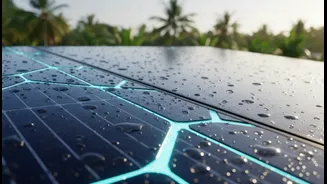
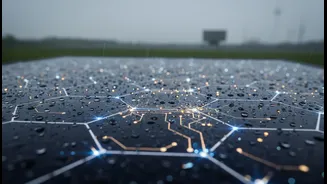
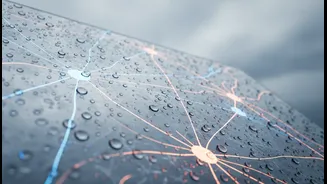
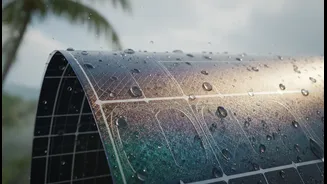
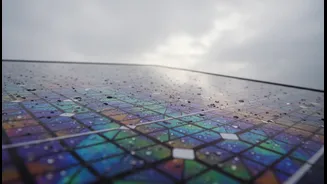
The second innovation sounds like science fiction: solar panels that generate electricity from falling raindrops. This is achieved by integrating a transparent layer on top of a solar cell called a Triboelectric Nanogenerator, or TENG. A TENG harvests kinetic energy. When a raindrop hits the specially coated surface and slides down, the friction creates a small electrical charge, much like static electricity. While the power from a single drop is tiny, an entire panel during a downpour can generate a measurable current. Chinese and Spanish researchers have developed hybrid panels that successfully integrate these technologies, demonstrating that a single device can harvest energy from both sunlight and rain. This turns a problem—rain—into another power source.
From the Lab to the Grid
While these technologies are incredibly promising, they are not yet mainstream. Perovskite cells still face challenges in long-term durability and scaling up manufacturing to compete with the established silicon industry, though progress is rapid. Similarly, the power output from the TENGs in hybrid panels is currently modest and serves more as a supplementary source. The coatings need to be durable enough to withstand years of harsh weather. However, the proof of concept is solid. Prototypes are becoming more robust and efficient, with some demonstrating the ability to power small electronic devices purely from raindrop energy. The journey from laboratory success to widespread commercial deployment will require further investment in research, development, and manufacturing infrastructure.