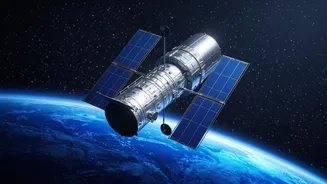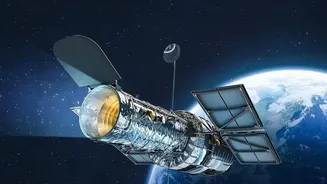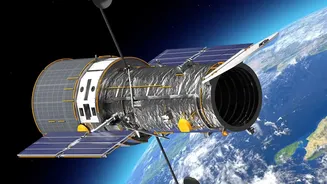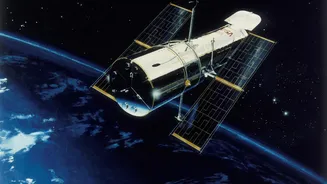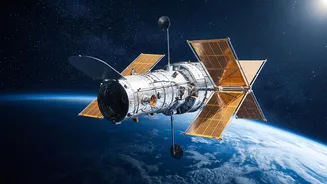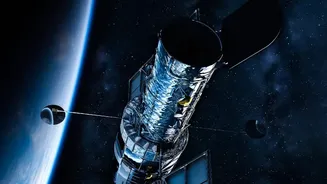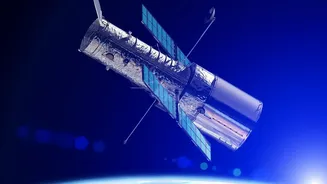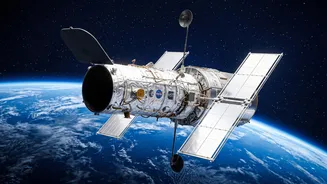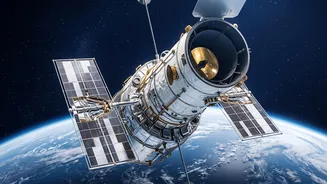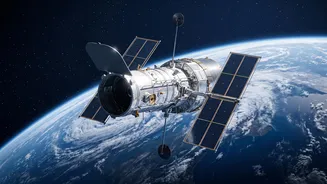



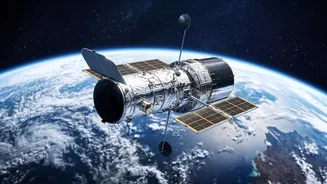
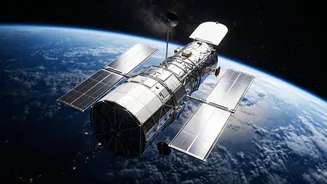
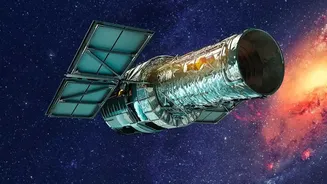
For over 35 years, the Hubble Space Telescope has been humanity's eye on the cosmos. But its orbit is slowly decaying, and without a little help, it could fall back to Earth. Now, NASA is looking for a modern solution to an old problem.
Why Hubble Needs a Lift
The Hubble Space
Telescope has no engine of its own. Launched in 1990, it was placed in a low-Earth orbit roughly 612 kilometres high. But even at that altitude, there are traces of Earth's atmosphere that create a tiny amount of drag. Over decades, this microscopic friction has caused Hubble's orbit to slowly shrink. It now orbits at an altitude of about 470 kilometres. Without an intervention, NASA projects the telescope could make an uncontrolled reentry into the atmosphere sometime between 2033 and 2034. To prevent this, a mission would need to reach Hubble by 2032 to push it back into a higher, more stable orbit.
A New Strategy for an Old Friend
In the past, saving Hubble was a job for the Space Shuttle. Astronauts conducted five different servicing missions between 1993 and 2009, making repairs, upgrading instruments, and boosting the telescope's orbit. The last boost was in 2002. But with the shuttle fleet retired since 2011, NASA needs a new way to reach its iconic observatory. Instead of building a new government-led mission from scratch, the agency is turning to the rapidly growing commercial space industry. This approach reflects a major shift in the business of space, where private companies are increasingly providing services that were once the exclusive domain of national space agencies.
Putting Out the Call
In late October 2026, NASA issued a formal 'Request for Information' (RFI). This is not a contract for a rescue mission but a way for the agency to conduct market research. NASA is asking private companies to submit their ideas and technical concepts for how they could help Hubble by a deadline of November 30, 2026. The RFI outlines three main possibilities: a simple reboost to a higher orbit, a more complex servicing mission to enhance its capabilities, or a controlled de-orbit to safely dispose of the telescope at the end of its life. This allows NASA to weigh the costs and benefits of various commercial solutions before committing any funds.
Who Could Answer?
While no company has been selected, the RFI is designed to attract a wide range of proposals. A 2022 study, conducted at no cost to NASA, explored the feasibility of using a SpaceX Dragon spacecraft for a reboost mission. While NASA decided not to pursue that specific effort at the time, the new RFI reopens the door for SpaceX and other players. Companies specializing in robotics and in-space servicing are expected to show significant interest. For instance, Astroscale and Momentus have previously collaborated on a proposal to use an orbital service vehicle to robotically capture and raise Hubble's orbit. The challenge is significant: Hubble was designed for servicing by astronauts, not robots, making any capture and docking a complex task.
What's at Stake for Science
Extending Hubble's life is about more than just preserving a piece of history; it's about safeguarding a unique scientific asset. Hubble remains one of the most productive scientific instruments ever built, and it is the only major observatory that can see in both visible and ultraviolet light. Its successors, like the James Webb Space Telescope, are designed to see primarily in the infrared. Boosting Hubble to a 600-kilometre orbit could add 25 years or more to its operational life, allowing it to continue making discoveries into the 2030s and beyond while the next generation of observatories, like the Habitable Worlds Observatory, are being developed for the 2040s. This new commercial approach could provide an innovative, cost-effective way to ensure Hubble's invaluable work continues.