





The Allure of Endless Night
Imagine a place so cold it makes Pluto seem balmy. These are the Moon’s Permanently Shadowed Regions, or PSRs. Located in deep craters near the lunar poles, their floors are perpetually tilted away from the Sun. Temperatures can plummet to an astonishing
minus 250 degrees Celsius. For scientists, this extreme cold is a feature, not a bug. It turns these craters into perfect cosmic freezers, capable of preserving volatile compounds like water ice that would otherwise evaporate in the harsh lunar environment. Discovering and quantifying this water is a primary goal for space agencies worldwide. It could one day be converted into drinking water, breathable oxygen, and even rocket fuel, making the dream of a sustainable lunar base a tangible possibility.
ISRO's Groundbreaking Toolkit
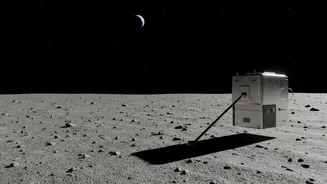
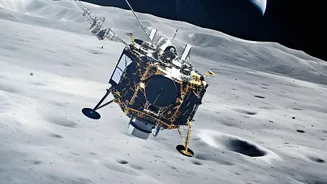
To study what lies beneath the surface of these dark zones, you need special tools. ISRO’s answer is a suite of sophisticated instruments, most notably the Chandra’s Surface Thermophysical Experiment (ChaSTE) probe that flew aboard the Chandrayaan-3 lander. Developed by ISRO-affiliated labs, ChaSTE is not a drill in the traditional sense. It’s a slender, 10-centimetre-long thermal probe designed for a gentle, controlled insertion into the lunar soil, known as regolith. This slow penetration minimizes disturbance to the very layers it intends to study. The probe is studded with ten high-precision temperature sensors, which take readings at various depths as it descends. The goal is to create a detailed thermal profile of the top layer of the Moon, something never done before at the lunar south pole.
How the Sensors Reveal Secrets
The ChaSTE probe operates in two main ways. First, in a passive mode, it simply measures the existing temperature at different depths, revealing how heat from the sunlit surface struggles to travel down through the regolith. Early results from Chandrayaan-3 showed a surprisingly large temperature drop—from around 45-50 degrees Celsius at the surface to as low as minus 10 Celsius just 10 centimetres below. This confirmed that the lunar topsoil is an incredibly effective insulator. Second, the probe can enter an active mode. A tiny heater near its tip warms the surrounding soil, and the sensors track how that heat dissipates. By analysing this thermal conductivity, scientists can infer crucial properties of the regolith, such as its density and composition, without ever needing a visual. This indirect data is vital for understanding the ground truth of these unexplored regions.
What Makes This Data 'Unmatched'
The term "unmatched" isn't just about technological superiority; it's about pioneering a new frontier. While Apollo missions also studied heat flow, they did so near the Moon's equator. ISRO’s Chandrayaan-3 provided the first-ever in-situ thermal profile from the high-latitude south polar region. This is the first time anyone has physically measured the thermal properties of the soil in this specific, resource-rich area. The data provides a crucial ground truth that orbital scans from instruments like NASA's Lunar Reconnaissance Orbiter can only estimate. Furthermore, ISRO's broader lunar program, including the Dual-Frequency Synthetic Aperture Radar (DFSAR) on the Chandrayaan-2 orbiter, is providing complementary data, helping to detect signs of subsurface ice from above. This multi-pronged approach gives ISRO a unique and comprehensive dataset.
Informing the Next Giant Leap
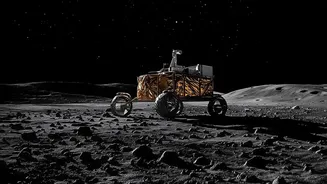
The data from these sensors is more than just a scientific curiosity; it's a roadmap for the future. Understanding the thermal and physical properties of the regolith is critical for designing future rovers and landers. It informs how to build foundations for habitats and how to design drills that can penetrate the soil to extract resources like water ice. The findings from Chandrayaan-3 are already shaping the joint ISRO-JAXA Lunar Exploration (LUPEX) mission, which will deploy a more advanced rover to search for water. LUPEX aims to drill up to 1.5 meters deep, directly measuring and analysing water content. By providing the initial characterisation of the terrain, ISRO’s current sensors are paving the way for more ambitious exploration and, eventually, the establishment of a human foothold on the Moon.