

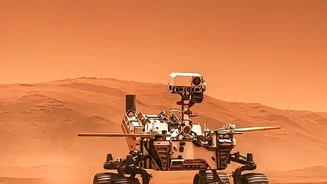
The Red Planet's Hidden Danger
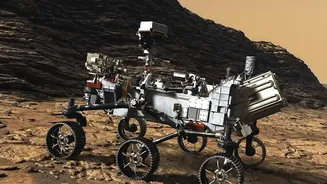
Mars is famously the 'Red Planet' because its surface is covered in a fine, rust-coloured dust. This material, called regolith, is the result of billions of years of meteorite impacts and geological processes. Unlike the sand on an earthly beach, Martian
dust is incredibly fine, with an average particle size of just three micrometres—small enough to bypass the human body's natural respiratory defences. The experience of Apollo astronauts with lunar dust, which caused irritation and hay fever-like symptoms, serves as a stark warning. However, Martian dust presents its own unique and arguably more severe set of challenges. It has electrostatic properties, meaning it clings to everything it touches, from solar panels to the outside of a space suit, making it incredibly difficult to keep out of living quarters.
A Toxic Chemical Cocktail
The danger of Martian dust is not just physical; it's also chemical. Analysis from Mars rovers and landers has revealed that the soil contains a cocktail of toxic compounds. Chief among these are perchlorates, a class of salt that is widespread across the planet's surface in concentrations considered toxic to humans. If inhaled, these reactive compounds can interfere with the thyroid gland, which is crucial for regulating metabolism. This could lead to serious health issues, including anaemia and other hormonal problems, for astronauts on long-duration missions. Beyond perchlorates, the dust also contains other potentially harmful substances like gypsum and traces of heavy metals such as arsenic, chromium, and beryllium.
As Dangerous as Glass Shards
On a microscopic level, Martian dust particles can be sharp and abrasive. The dust is rich in silica, the same compound that poses a major risk to miners and glassblowers on Earth. Prolonged inhalation of fine silica particles can lead to silicosis, an incurable and progressive lung disease where the lung tissue becomes scarred, making it difficult to breathe. The effect is similar to the 'black lung' disease seen in coal miners. Because the dust particles are so small, they can lodge deep within the lungs and even potentially enter an astronaut's bloodstream, creating systemic health problems. This physical damage is a serious threat, as there is currently no cure for silicosis aside from a lung transplant—an impossible option millions of kilometres from Earth.
An Inescapable Contaminant
One of the biggest engineering challenges is simply keeping the dust out. After any extravehicular activity (EVA), or spacewalk, astronauts will inevitably bring dust back with them, clinging to their suits. As experienced during the Apollo missions, this dust can then get dispersed inside the airlock and living spaces. The particles are so fine and pervasive that they can compromise seals, interfere with sensitive scientific equipment, and contaminate the breathable air inside the habitat. Global dust storms, which can envelop the entire planet for weeks, would dramatically increase the amount of airborne dust, posing an even greater threat to both machinery and human health. Preventing this contamination is not a luxury but a fundamental requirement for a sustainable presence on Mars.
Engineering a Breath of Fresh Air
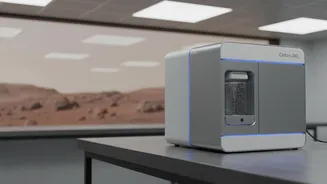
To safely live on Mars, future habitats must be designed with dust mitigation as a core principle. This will require a multi-layered approach. Advanced air filtration systems, far more sophisticated than standard HEPA filters, will be essential. Some proposed designs include multi-stage filters with magnetic components to attract the iron oxides in the dust or electrostatic precipitators that use electric fields to remove particles from the air. Spacesuit technology must also evolve. This could involve self-cleaning suit materials, removable outer covers that can be discarded before entering the airlock, or 'suit-ports' that allow an astronaut to dock their suit with the habitat's exterior and enter without ever bringing the dusty suit inside. Furthermore, technologies like electrostatic dust shields, which use electric fields to actively repel dust from surfaces like solar panels and habitat exteriors, are being developed to combat the problem at its source.