



The Seated Power of Kayaking
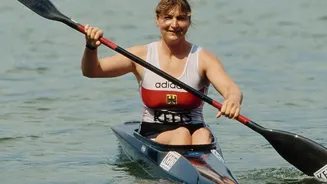
When you picture kayaking, you might think it is all an arm workout. While your arms and shoulders are certainly involved, the real engine of a powerful kayak stroke comes from your core. In a seated position, your centre of gravity is low, providing
a stable base. This stability allows you to focus on generating force through rotation. As you pull the double-bladed paddle through the water, your torso twists. This movement heavily engages your obliques (the muscles on your sides) and rectus abdominis. Your core acts as the crucial link, transferring power from your hips and legs—which press against the kayak for leverage—through your torso and into your arms to propel the boat forward. It is a dynamic, repetitive motion that builds rotational strength and endurance in your midsection.
The Standing Challenge of Paddleboarding
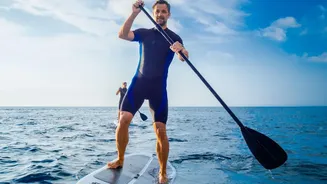
Stand-up paddleboarding (SUP) presents a completely different stability challenge. By standing on the board, you raise your centre of gravity, creating an inherently unstable surface. Your body must constantly work to maintain balance, turning the activity into a full-body workout. This process starts from the ground up. The small, fast-twitch muscles in your feet and ankles are perpetually making micro-adjustments. This engages your legs, glutes, and, most critically, your deep core muscles. Unlike kayaking's focus on generating power, SUP is about maintaining equilibrium. Your core—including your abs, obliques, and lower back—is continuously firing to keep you upright against the shifting water. The paddle stroke adds another layer, requiring your core to stabilize your body while your upper body works.
Dynamic Rotation vs. Static Stabilization
The core difference between the two lies in the type of stability required. Kayaking develops dynamic core strength through powerful, repetitive rotation. Think of it as training your core to be an engine for movement. Each paddle stroke is a controlled twist that strengthens your obliques and improves your ability to transfer force across your body. Stand-up paddleboarding, on the other hand, builds reactive and static stability. Your core isn't just working when you paddle; it is working nonstop to keep you balanced. This constant engagement strengthens the deep stabilizer muscles of your torso and improves your proprioception, which is your body's awareness of its position in space. It is less about generating force and more about resisting it to maintain posture and balance.
Which Is Better For Your Core?
Neither sport is definitively 'better' for your core; they simply train it in different ways. The best choice depends on your fitness goals. If you want to build rotational power, which is useful for sports like golf, tennis, or hockey, kayaking offers a targeted workout. The twisting motion directly strengthens the muscles responsible for powerful torso rotation. If your goal is to improve overall balance, posture, and deep core stabilization for functional, everyday strength, paddleboarding is an excellent option. Because it engages your entire body from your feet to your shoulders in a constant balancing act, SUP provides a more holistic core conditioning experience. For this reason, many consider paddleboarding to be a more complete full-body workout.
Beyond the Core: A Whole-Body View
While core stability is a key differentiator, it's worth noting the other benefits. Kayaking provides a more intense upper-body and back workout, specifically targeting your lats, shoulders, and arms with every pull of the paddle. Your legs play a supporting, stabilizing role. In contrast, stand-up paddleboarding is a true full-body challenge. Your legs and glutes are constantly engaged to maintain your stance, making it a more comprehensive lower-body workout compared to kayaking. Ultimately, both activities offer fantastic physical benefits and a chance to enjoy the outdoors. The choice between them comes down to whether you prefer the rhythmic, power-based workout of kayaking or the full-body balancing challenge of paddleboarding.