


A Whisper From the Void
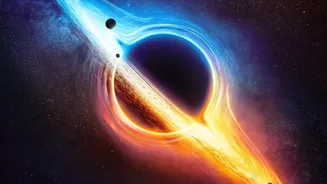
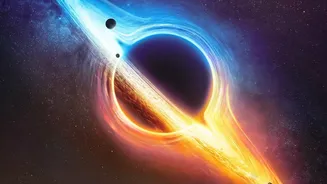
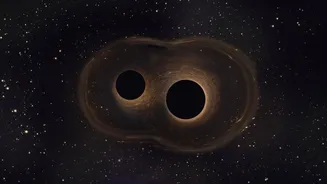
In a major announcement, an international team of scientists confirmed the detection of gravitational waves—subtle tremors in the fabric of spacetime itself—from the violent collision of two intermediate-mass black holes (IMBHs). These cosmic behemoths,
weighing in at hundreds of times the mass of our sun, spiralled into each other millions of light-years away, unleashing a burst of energy that travelled across the universe. The incredibly sensitive detectors of the LIGO-Virgo-KAGRA (LVK) collaboration, a network of observatories in the United States, Europe, and Japan, were able to 'hear' this cataclysmic event, marking a pivotal moment in astronomy. For years, these observatories have been listening for the gravitational symphony of the cosmos, and this latest detection is one of the most significant notes they have ever recorded.
The 'Missing Link' of Black Holes
For decades, astronomers have been puzzled by a gap in the black hole family tree. They have found plenty of small, 'stellar-mass' black holes (a few dozen times the sun's mass) which are the remnants of massive, exploded stars. They have also confirmed the existence of supermassive black holes, millions or billions of times our sun's mass, which sit at the heart of nearly every large galaxy, including our own Milky Way. But the black holes in between—the intermediate-mass ones—have been notoriously elusive. With masses ranging from 100 to 100,000 times that of the sun, IMBHs have been called the universe's 'missing link'. Finding them, especially finding them in the act of merging, provides the first direct, concrete evidence that this crucial middle class of black holes truly exists and is active.
How to Build a Monster
The discovery of merging IMBHs provides the strongest clue yet to solving the puzzle of how supermassive black holes get so big. One of the leading theories is that they grow through a process called hierarchical merging. The idea is that smaller, stellar-mass black holes collide to form IMBHs. These IMBHs, in turn, sink to the centers of galaxies where they merge with other IMBHs, gradually building up to supermassive status over cosmic timescales. Until now, this was largely a theoretical model. This new observation acts as a cosmic snapshot, capturing the process in action. It's like finding a fossil of a teenager after only ever seeing infants and adults—it proves the growth stage is real. These events demonstrate a viable pathway for black holes to grow from stellar-mass seeds into the galactic monsters we see today.
A New Era for Cosmic Cartography
This discovery doesn't just confirm a theory; it opens up a completely new way to map the evolution of the universe. Gravitational wave astronomy allows us to observe events that are invisible to traditional telescopes, which rely on light. The violent merger of two black holes is a dark event, but it sends incredibly powerful ripples through spacetime. By studying the precise 'shape' of these waves, scientists can deduce the masses, spins, and distance of the merging objects with astonishing accuracy. With each detection, we gather more data points to chart the unseen structures of the cosmos. As observatories become even more sensitive, astronomers expect to detect these IMBH mergers more frequently, creating a detailed census of this once-hidden population and learning how galaxies assemble themselves.