




It's a staple on cheese boards and a perfect partner to poppadoms, but the story of chutney is far richer than the contents of a single jar. This beloved condiment's journey begins with a simple Hindi word: 'chatni'.
A Word You Can Almost Taste
The English word 'chutney' is a direct
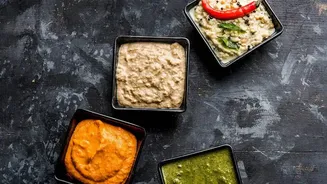
descendant of the Hindi 'chatni', which stems from the verb 'chatna', meaning 'to lick' or 'to taste'. This evocative origin points to the fundamental purpose of a chutney: a flavour-packed condiment so delicious you’d want to lick the spoon. In India, chutneys were traditionally made by grinding fresh ingredients with a mortar and pestle. This process created vibrant, potent relishes designed to accompany and elevate a meal, balancing flavours and textures. From cooling mint and coriander chutneys in the north to tangy tamarind and coconut versions in the south, the variety has always been immense.
The Two Worlds of Chutney
A key distinction exists between traditional Indian chutneys and the version most familiar in the West. Indian 'chatni' is often a fresh, uncooked preparation, meant to be made and consumed the same day. It can be smooth or coarse, and its role is integral to the meal, providing a burst of fresh flavour to complement staples like rice, dosas, and samosas. Common bases include coconut, mint, coriander, tomato, and tamarind. In contrast, the chutneys that lined the pantries of British households evolved into something quite different: a cooked, preserved condiment more akin to a savoury jam.
The British Adaptation
During the colonial era, British officials and their families in India developed a taste for local flavours, including chutney. However, the fresh, perishable nature of Indian chutneys made them unsuitable for the long sea voyage back to Britain. To solve this, British cooks adapted the recipes, adding sugar and vinegar as preservatives. This transformed the condiment, creating the thick, sweet, and tangy fruit-based chutneys that became popular in the UK. Mango was a favourite, but British producers also used local produce like apples, plums, and onions to create new variations.
The Legend of Major Grey
No discussion of anglicised chutney is complete without mentioning Major Grey's Chutney. This famous mango-based recipe, featuring raisins, onions, and spices, is said to have been created for a 19th-century British Army officer of the same name who wanted a milder, sweeter flavour. While Major Grey was most likely a mythical figure, his name became synonymous with the archetypal Anglo-Indian chutney. Brands like Crosse & Blackwell helped popularise the style, and it became the standard-bearer for chutney in the West, particularly in the United States where it remains a popular variety.
From Condiment to Global Ingredient
The journey of chutney didn't stop in Britain. It spread throughout the British Empire, taking root in South African and Caribbean cuisines. Today, chutney is a truly global food. The sweet, preserved style has become a classic pairing for cheese boards, cold meats, and sandwiches, a fixture of the British 'Ploughman's Lunch'. At the same time, a growing appreciation for diverse global cuisines has introduced food lovers everywhere to the fresh, vibrant world of authentic Indian chutneys, from fiery garlic pastes to earthy curry leaf and nutty peanut versions.