




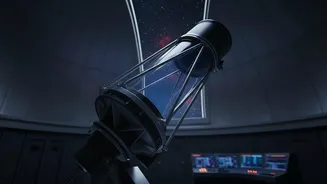
The Cosmic Neighbourhood Watch
Near-Earth objects are asteroids and comets nudged by gravitational forces into orbits that bring them close to our planet. While a direct hit from a city-killer-sized asteroid is a rare event, the consequences would be catastrophic. Even smaller objects,
like the 20-metre meteor that exploded over Chelyabinsk, Russia, in 2013, can cause significant regional damage and injuries from their shockwaves. The goal of planetary defense is to find these objects long before they find us. This involves not just a single discovery but a sustained, global effort to catalogue and track them, turning a potential surprise into a predictable and manageable risk.
The Challenge of Finding a Needle in the Dark
Detecting NEOs is incredibly challenging. Many are small, dark, and fast-moving, reflecting very little sunlight, which makes them faint targets for telescopes. Ground-based observatories are also limited by weather, atmospheric interference, and the simple fact that they can only operate during the night. A significant blind spot exists for objects approaching from the direction of the sun, as they are lost in its glare. A single observation from one telescope provides only a fleeting snapshot. To understand an object's path, astronomers need multiple data points over time. Without this, a potential threat can easily be lost again in the vastness of space.
Why A Network Is Essential
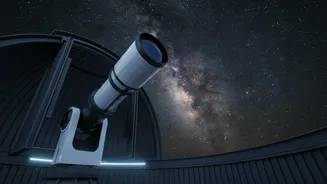
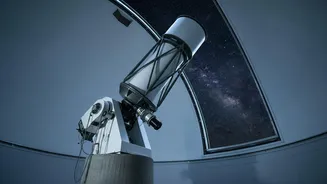
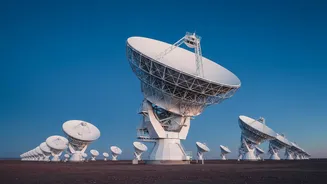
This is where the power of a network comes in. Systems like the NASA-funded Asteroid Terrestrial-impact Last Alert System (ATLAS) use multiple telescopes spread across the globe. ATLAS operates observatories in Hawai'i, Chile, and South Africa, allowing it to scan the entire dark sky every 24 hours. This geographical distribution overcomes the limitations of a single location. When it is daytime in one hemisphere, it is night in the other, ensuring continuous coverage. This global collaboration means that more eyes are on the sky, reducing the chances that an object will slip by undetected and enabling the rapid follow-up observations needed to confirm a discovery.
From a Single Dot to a Clear Path
When a survey telescope detects a new moving point of light, it is just the beginning. The initial data is sent to a central clearinghouse, the Minor Planet Center, where it is made available to the global astronomy community. Other observatories then perform follow-up observations to gather more data points. With each new observation, the object's orbit is calculated with increasing precision. Centres like NASA's Center for Near-Earth Object Studies (CNEOS) use this data to model the object's trajectory far into the future, determining if it poses any impact risk over the next century or more. This long-term tracking is what transforms a simple detection into a reliable forecast.
Global Players in Planetary Defence
The effort is a massive international collaboration. Major NASA-funded ground-based surveys include ATLAS, the Catalina Sky Survey in Arizona, and Pan-STARRS in Hawaii. These projects have collectively discovered the vast majority of known NEOs. India also contributes through initiatives like the GROWTH-India telescope in Ladakh, a fully robotic facility that can track fast-moving objects, and citizen-science programmes like the All India Asteroid Search Campaign (AIASC), which allow students to participate in the global hunt. The future holds even greater capabilities, with the Vera C. Rubin Observatory in Chile expected to discover millions of new objects and space-based telescopes like the NEO Surveyor set to eliminate ground-based blind spots.