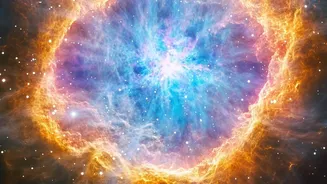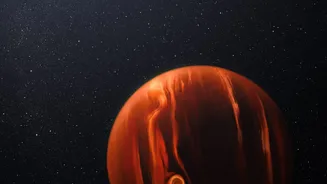


Often called 'failed stars', brown dwarfs have long occupied a mysterious space between stars and planets. Now, a groundbreaking new study using NASA's SPHEREx telescope is revealing just how beautifully complex and different they truly are.
Cosmic Misfits: What Are Brown Dwarfs?
Imagine an
object that forms from a collapsing cloud of gas and dust, just like a star. It grows massive, becoming many times bigger than Jupiter. Yet, it never quite gathers enough mass to ignite the engine of nuclear fusion in its core that makes stars shine. This is a brown dwarf. They are not stars, but they are not quite planets either. They drift through the cosmos, glowing dimly not from fusion, but from the leftover heat of their formation. First theorized in the 1960s and discovered in the 1990s, these objects are more than just cosmic curiosities. They represent a crucial link in understanding the formation of both stars and planetary systems. Despite their name, they are not actually brown; depending on their temperature, they would likely appear magenta or deep red to our eyes.
A New Eye on the Sky: The SPHEREx Mission
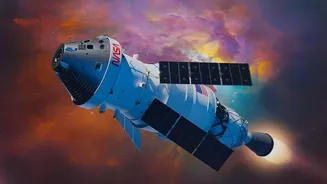
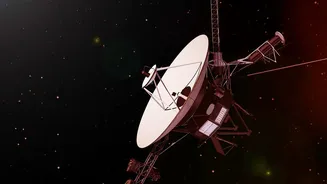
To study these dim, distant objects, astronomers need powerful tools. Enter SPHEREx (Spectro-Photometer for the History of the Universe, Epoch of Reionization, and Ices Explorer), a NASA space telescope launched in 2025. Its mission is to scan the entire sky every six months in infrared light, which is invisible to the human eye but perfect for detecting the faint heat of objects like brown dwarfs. What makes SPHEREx so revolutionary is its ability to perform spectroscopy across the whole sky, observing it in 102 different infrared colors. This technique allows scientists to break down the light from any object and identify the chemical signatures of the molecules within it, essentially taking a chemical fingerprint of distant worlds. While SPHEREx has grand goals like studying the early universe and the origins of galaxies, this powerful capability has made it an unparalleled tool for investigating brown dwarfs.
A Spectrum of Differences
The latest study, published in The Astrophysical Journal, analyzed dozens of nearby brown dwarfs and confirmed what models had only hinted at: no two brown dwarfs are exactly alike. Even when two have the same temperature, their chemical compositions can be strikingly different. The SPHEREx data revealed a rich assortment of molecules in their atmospheres, including water, methane, carbon monoxide, and carbon dioxide. The key finding is how this atmospheric chemistry changes from one brown dwarf to another. Some are dominated by thick, exotic clouds, while others, as they cool, enter a transitional phase where these clouds thin out, allowing a methane-rich atmosphere to become visible. This diversity in cloud cover and chemistry explains why astronomers have been so puzzled by them in the past.
Why This Diversity Matters
This newfound variety is not just a cosmic novelty; it is a treasure trove of information. The differences between brown dwarfs can tell us about the environments in which they were born. A brown dwarf that formed in a gas cloud rich in heavy elements (what astronomers call 'metals') will have a different atmospheric signature than one born in a more pristine, metal-poor region. Furthermore, studying their atmospheres, which are much easier to observe than those of exoplanets hidden by the glare of a host star, provides a natural laboratory for understanding planetary weather and chemistry. Scientists studying the data have described themselves as 'accidental meteorologists', as they are now delving into the physics of cloud formation and atmospheric dynamics on these lonely worlds. Understanding these processes helps refine the models used to study the atmospheres of potentially habitable exoplanets.
The Next Chapter for Stellar Science
The initial study looked at just a few dozen brown dwarfs, but this is only the beginning. SPHEREx is surveying the entire sky, and scientists are in the process of analyzing thousands more of these objects. This massive dataset will provide an unprecedented statistical understanding of the brown dwarf population, helping to map out their evolution, clarify the boundary between giant planets and small stars, and test the limits of our atmospheric models. As one scientist put it, the findings are a 'call to action to explore even more of these dark worlds'. Each unique brown dwarf spectrum adds another piece to the puzzle of how stars and planets come to be, transforming these 'failed stars' into a major success story for astronomy.