


Webb's Enigmatic Red Dots
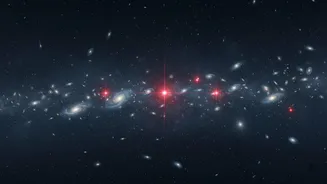
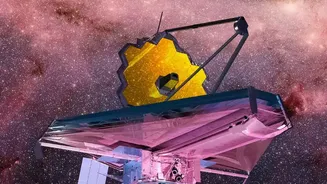
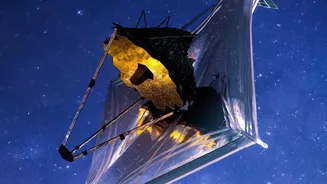
Since it began operations, the JWST has spotted hundreds of faint, compact objects in the early universe, nicknamed 'little red dots' (LRDs). These objects existed around 600 million to 1.6 billion years after the Big Bang, making them some of the most
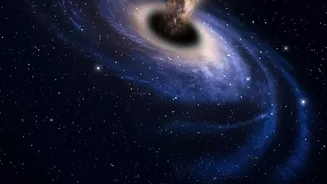
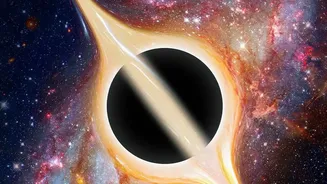
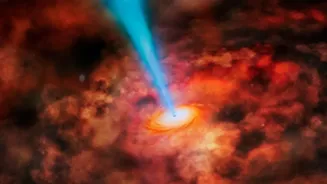
distant things ever seen. For astronomers, they are a profound mystery. The leading theory suggests many LRDs are a previously unseen type of active galactic nucleus (AGN)—essentially, supermassive black holes furiously consuming gas and dust at the centre of young galaxies. However, they don't behave exactly like the AGNs we see in the modern universe, leading to a hot debate and a race to explain their true nature. Some theories even propose they are a new type of gigantic, primordial star.
The Science of Seeing Red
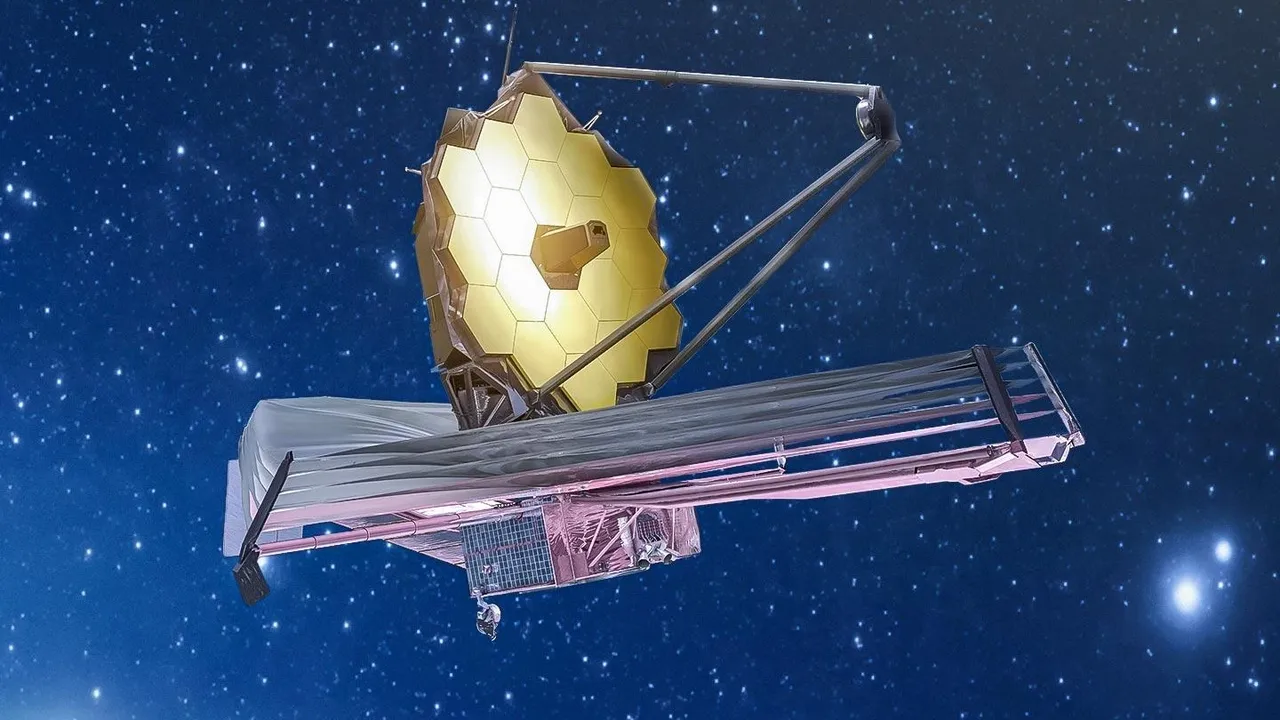
The reason these dots, and other extremely distant objects, appear red is a phenomenon called cosmological redshift. It's not a Doppler effect, which is caused by an object moving through space. Instead, cosmological redshift happens because space itself is expanding. As light travels for billions of years across the expanding universe, its waves get stretched out. Longer light waves shift toward the red end of the electromagnetic spectrum. Therefore, the 'redder' an object appears, the farther away it is and the further back in time we are seeing it. The JWST is specifically designed with powerful infrared detectors to capture this stretched-out light from the dawn of time.
Bridging the Gap to Amateur Astronomy
While you won't be discovering your own LRDs with a backyard telescope—these objects are far too faint and distant—the principles used to study them can inspire your own deep-space observations. Professional astronomers and amateurs have a long history of collaboration, with skilled hobbyists discovering supernovae, comets, and even new galaxies. The key is not to compete with multi-billion-dollar space telescopes, but to apply similar techniques on a different scale. This involves learning to capture and analyse the faintest possible light from distant cosmic targets accessible with your equipment.
Techniques for Your Own Deep-Sky Research
The foundation of deep-sky astrophotography is collecting as much light as possible. This means using long exposures, sometimes lasting several minutes per frame. To get a clean, detailed final image, amateurs use a technique called 'stacking.' This involves taking dozens or even hundreds of long-exposure shots of the same object and then using software to combine them. This process averages out random noise from the camera sensor and atmosphere, dramatically enhancing the faint details of distant galaxies and nebulae. Using different filters, including narrowband filters like Hydrogen-alpha, can help isolate specific features within these galaxies, allowing you to study their structure in a way that mimics professional analysis.
Join the Hunt with Citizen Science
Perhaps the most powerful way for any space enthusiast to contribute to cutting-edge research is through citizen science. Platforms like Zooniverse host dozens of projects where you can directly analyse real data from professional telescopes, including the JWST. In projects like Galaxy Zoo or Dark Energy Explorers, volunteers classify the shapes of thousands of galaxies, helping astronomers understand galactic evolution. Others, like Planet Hunters, involve looking for the tell-tale dips in starlight that signal the presence of an exoplanet. In India, the RAD@home project specifically engages students in research on black hole-galaxy co-evolution using data from the Giant Metrewave Radio Telescope (GMRT). These projects require no special equipment, just a computer and a keen eye for detail, allowing you to be part of the next big discovery from your own home.