





The Universe’s Coolest Experiment
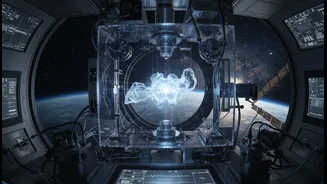
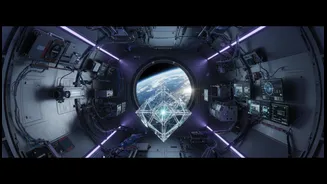
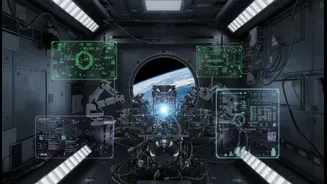
Aboard the International Space Station (ISS), NASA's Cold Atom Laboratory (CAL) is a unique physics facility. Its primary mission is to chill atoms to temperatures just a fraction of a degree above absolute zero, far colder than deep space. In this extreme
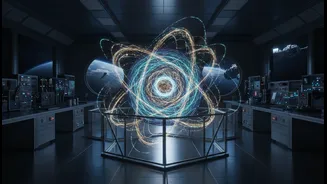
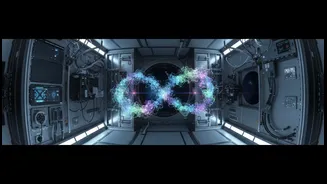
state, atoms slow to a crawl and can form a fifth state of matter called a Bose-Einstein condensate (BEC). Within a BEC, atoms lose their individual identities and behave like a single, massive quantum wave. The microgravity environment of the ISS is crucial, as it allows scientists to observe these condensates for much longer periods than possible on Earth, where gravity quickly pulls them apart. This provides an unprecedented window into the fundamental rules of the quantum world.
Sensing the Unseen
One of the most immediate applications of this ultra-cold atom technology is in precision measurement. By manipulating these quantum waves, scientists can create incredibly sensitive instruments called atom interferometers. These devices can detect minute variations in forces like gravity, rotation, and magnetic fields with an accuracy that far surpasses current technologies. On the ISS, CAL has already demonstrated that these quantum sensors are robust enough to work in space, even measuring the subtle vibrations of the station itself. This capability is more than a scientific curiosity; it’s a proof of concept for a new generation of sensors that could one day provide high-precision maps of Earth's gravity, improve navigation where GPS is unavailable, and even help in the search for geological resources.
From Lab to a Commercial Frontier
While the fundamental physics is groundbreaking, the real long-term opportunity lies in translating these capabilities into commercial applications. The CAL is not just a science experiment; it’s a testbed for maturing quantum technology for reliable use in space. This is what some call the “Quantum 2.0” revolution, moving from the discoveries that gave us lasers and MRIs to the direct manipulation of quantum states for new technologies. The ISS provides a unique platform for industry and government to collaborate on this frontier. By proving these technologies can operate in orbit, NASA is paving the way for private companies to develop and deploy space-based quantum systems. This includes everything from ultra-secure communication networks to advanced Earth observation satellites.
The Future of Quantum in Orbit
The technologies being refined in the Cold Atom Lab are foundational for a future where quantum systems are integral to space infrastructure. Quantum sensors promise to enable spacecraft to navigate autonomously on missions to the Moon or Mars without relying on GPS. Quantum communication could offer ultra-secure data transmission, protecting everything from financial transactions to sensitive government communications relayed via satellite. Further down the line, some envision a space-based “quantum internet,” a network of quantum computers that could tackle complex optimization problems, such as managing increasingly crowded satellite constellations or accelerating scientific discovery through powerful simulations. The work done on CAL is a crucial first step in building the hardware and expertise needed for this future.
A New Platform for Innovation
Ultimately, the ISS has been designated as a national laboratory, with a goal of increasing its use by the private sector. The Cold Atom Lab, which has been upgraded multiple times since its installation in 2018, perfectly embodies this mission. It demonstrates that complex, cutting-edge facilities can be maintained and improved in orbit, reducing the need for costly return missions. This provides a stable, long-term platform for researchers and commercial innovators to test new ideas. As companies like Infleqtion and others partner with NASA to build next-generation quantum payloads, the CAL serves as a powerful example of how public investment in fundamental research can de-risk new technologies and open up entirely new markets. It is transforming low-Earth orbit from a place of pure exploration into a bustling hub for commercial R&D.