






The Philosophy of One Pot
The beauty of the Indian one-pot meal lies in its elegant simplicity and profound versatility. It’s a complete meal where rice, lentils, and often vegetables, are cooked together, allowing their flavours to meld into a harmonious whole. This method of cooking
is not just about convenience; it’s a deeply ingrained cultural practice that reflects a philosophy of nourishment, comfort, and resourcefulness. From the Himalayas to the coastal south, the basic formula adapts to local tastes, seasonal produce, and festive occasions, yet the soul of the dish remains the same: wholesome, easy to digest, and deeply satisfying. [24, 25] It’s the food of childhood, of recovery, and of quiet celebration, proving that the most comforting meals don't require a sink full of dishes.
The All-India Icon: Khichdi
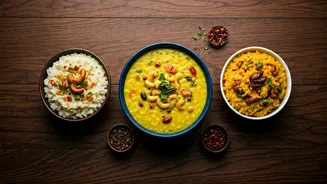
If one dish could represent the entire subcontinent, it would be Khichdi. Its history is ancient, with mentions in texts dating back over two millennia. The name itself derives from the Sanskrit word 'khiccā', meaning a dish of rice and legumes. [7, 10] Archaeologists have found evidence of rice and green gram cooked together in Maharashtra from 2,000 years ago. [10] Its reputation was solidified by travellers like Ibn Battuta in the 14th century and it even became a favourite in Mughal royal kitchens. [11, 15] Emperor Jahangir enjoyed a Gujarati version, while Aurangzeb appreciated its simplicity. [7] Today, its variations are endless: the soupy 'bhoger khichuri' of Bengal served during pujas, the millet-based versions in Rajasthan, and the piquant amla khichdi of Uttar Pradesh, often linked to Makar Sankranti. [16, 15] It is the ultimate comfort food, famously paired with its four best friends: 'dahi, papad, ghee aur achaar' (curd, poppadom, clarified butter, and pickle). [10]
South India’s Soulful Staple: Pongal
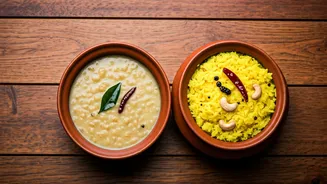
Travel south, and you'll find Pongal, Tamil Nadu's cherished equivalent. The name, which means "to boil over," is symbolic of abundance and prosperity and is central to the Tamil harvest festival of the same name. [14, 19] Pongal comes in two primary forms. There is the savoury 'Ven Pongal', a creamy porridge of rice and moong dal seasoned with black pepper, cumin, and ginger, often topped with ghee-fried cashews; it is a beloved breakfast dish. [5] Then there is 'Sakkarai Pongal', a sweet version made with jaggery, milk, and cardamom, frequently offered in temples as 'prasadam'. [5, 20] Though strongly associated with the festival, Pongal is a year-round comfort food, embodying warmth and gratitude in every spoonful. [19] Its comforting nature is similar to Khichdi, showcasing a shared culinary DNA across the country. [10]
Karnataka’s Crowning Glory: Bisi Bele Bath
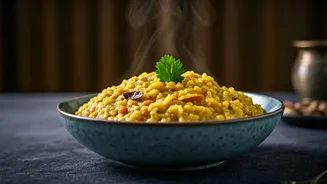
In Karnataka, the one-pot meal is elevated to an art form with Bisi Bele Bath, which translates to "hot lentil rice dish." [18, 22] Believed to have originated in the Mysore Palace, this dish is a complex and spicy medley of rice, toor dal, tamarind, and a host of vegetables like carrots and beans. [4, 17, 18] What sets it apart is its unique masala powder, a fragrant blend that can include up to thirty ingredients, creating a symphony of flavours that is tangy, spicy, and deeply aromatic. [18] While its preparation is more elaborate than a simple Khichdi, the result is a nutritionally balanced and incredibly flavourful meal that serves as a symbol of regional pride. [4, 12] It's a festive dish, a comfort food, and a perfect example of how the one-pot concept can be both simple and spectacularly grand. [12]
A Tapestry of Tastes
Beyond these famous names, the one-pot tradition thrives in countless other forms. In Uttar Pradesh, Tehri is a fragrant rice dish cooked with potatoes and other vegetables, believed to have been developed as a vegetarian alternative to biryani in Awadhi courts. [3, 13] The Parsi community has its own versions of Khichdi, sometimes incorporating fish or prawns. [16] In Bengal, Chorchori is a wonderful mixed vegetable dish that embodies the one-pot spirit of using whatever is on hand. [23] Each dish tells a story of its region's history, produce, and culinary ingenuity.