
A Cosmic Game of Shadow
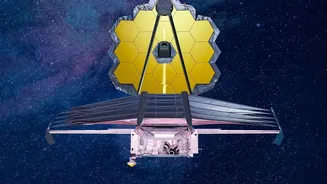
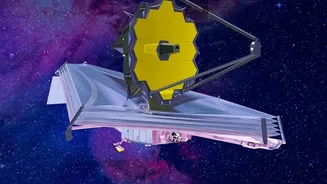
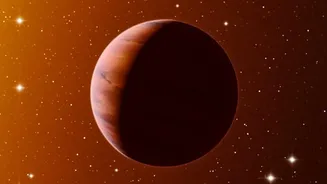
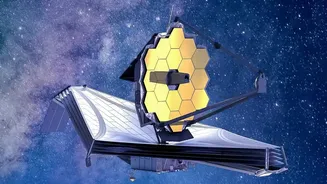
The entire process starts with a cosmic alignment that is both rare and incredibly useful. Scientists using the James Webb Space Telescope (JWST) look for exoplanets—planets outside our solar system—that perform a 'transit'. This means the planet passes
directly between us and its host star. When this happens, the planet blocks a tiny fraction of the star's light, causing a temporary, almost imperceptible dip in the star's brightness. This event is like a mini-eclipse. While the dimming itself is what helps astronomers discover exoplanets in the first place, for atmospheric scientists, the most exciting part happens at the very edges of this shadow.
An Atmosphere as a Filter
Just before and after the main transit, a sliver of the star's light passes directly through the exoplanet's atmosphere. This thin halo of gas and clouds acts like a filter. Different molecules in the atmosphere—like water vapour, methane, or carbon dioxide—absorb very specific colours, or wavelengths, of light. So, the starlight that emerges from the other side of the atmosphere is missing tiny pieces of its original spectrum. It carries a chemical fingerprint of the air on that alien world. This filtered light is what JWST is designed to capture and analyse with extraordinary precision.
Webb’s Infrared Vision
Here is where JWST’s superpower comes into play: its ability to see in infrared light. While our eyes see a rainbow of visible light, many of the most interesting chemical signatures are hidden in the infrared spectrum, which we feel as heat. Water, in particular, is a master at absorbing specific wavelengths of infrared light. Previous telescopes, like Hubble, could see parts of this spectrum, but JWST is designed to observe a huge range of infrared light with unmatched clarity. This allows it to hunt for molecules that were previously invisible to us, making it the ultimate tool for atmospheric detective work.
The Barcode in the Starlight
To read the chemical fingerprint, scientists use a technique called spectroscopy. Instruments aboard JWST, such as the Near-Infrared Spectrograph (NIRSpec), work like incredibly advanced prisms. They take the filtered starlight and spread it out into its full spectrum, like a rainbow. But when they look at this rainbow, it's not perfect. It has dark lines or gaps in it—an 'absorption spectrum'. Each gap corresponds to a specific wavelength of light that was absorbed by a molecule in the exoplanet's atmosphere. Every element and compound has a unique pattern of absorption lines, like a chemical barcode.
Identifying the Water Signature
Scientists have studied the barcode for water extensively in labs on Earth. They know exactly which wavelengths of infrared light a water molecule will absorb. When they analyze the spectrum from an exoplanet and see dark lines appearing at those exact, tell-tale positions, they can confidently say they have detected water vapour. The observation of WASP-96 b provided a classic example, where Webb captured the distinct signature of water. The more prominent these absorption lines are, the more water vapour is likely present in that planet's atmosphere. It’s this precise matching of the observed data to known chemical properties that turns a flicker of starlight into a groundbreaking discovery.
From Data to Discovery
Of course, it's rarely that simple. Astronomers must be incredibly careful. Sometimes, the star itself can have features, like cool starspots, that contain water vapour and could mimic a planetary signal. Scientists use sophisticated models to rule out these false positives and confirm that the water is indeed from the planet. They often use multiple instruments on Webb, like NIRSpec and MIRI, to observe the planet at different wavelengths, cross-checking the data to build a complete and reliable picture. Each confirmation is a triumph of engineering and a crucial piece of the puzzle in our search for other habitable worlds in the cosmos.