


A Chemical Factory in a Distant Galaxy
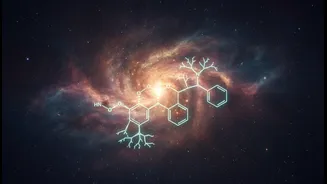
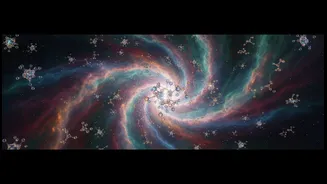
Astronomers using the powerful James Webb Space Telescope (JWST) have uncovered a treasure trove of complex organic molecules deep within a distant galaxy. The discoveries centre on galaxies like IRAS 07251-0248 and SPT0418-47, which are shrouded in thick
dust, making them difficult to study with conventional telescopes. The latter is over 12 billion light-years away, meaning we are seeing it as it was when the universe was just 1.5 billion years old. By peering through the cosmic dust using infrared light, researchers detected an extraordinary mix of carbon-rich compounds. This suggests that the fundamental building blocks for life are not just a local phenomenon but are widespread throughout the cosmos, and have been for a very long time.
Fingerprints in the Starlight
So how do you find a molecule from 12 billion light-years away? The answer lies in a technique called spectroscopy. The JWST is equipped with instruments that can split the light from a distant object into its constituent colours, much like a prism. Every molecule absorbs and emits light at specific, unique frequencies, creating a chemical "fingerprint". By analysing the infrared light from these galaxies, scientists identified the tell-tale signatures of a variety of organic molecules. In the case of the extremely distant galaxy SPT0418-47, this task was made possible by a cosmic coincidence called gravitational lensing, where the gravity of a closer galaxy magnified the light from the background one, making it appear about 30 times brighter and easier to observe.
The Building Blocks of Life
The molecules found are not just simple compounds; they are what astronomers call Complex Organic Molecules (COMs). It is important to note that what an astronomer calls 'complex'—a molecule with six or more atoms—might seem simple to a biologist. Nevertheless, these are significant discoveries. The findings include molecules like benzene and methane, as well as polycyclic aromatic hydrocarbons (PAHs), which on Earth are found in soot and smoke. Crucially, these carbon-based molecules are considered the basic building blocks for the earliest forms of life. Some discoveries even hint at the presence of molecules that could be precursors to amino acids, the building blocks of proteins. The presence of such molecules so early in the universe's history is a game-changer.
Rethinking Cosmic Chemistry
These findings are forcing scientists to rethink their models of cosmic chemistry. The abundance and complexity of the molecules found are far higher than many theoretical models predicted. It was once thought that the harsh radiation in the hearts of galaxies, especially those with active star formation or supermassive black holes, would destroy such complex molecules. However, the new data suggests these extreme environments might actually act as cosmic factories, fuelling a rich chemical network. The dust clouds that obscure the view also serve to protect these nascent molecules, allowing them to form and persist. This suggests that the raw ingredients for life could be seeded into new planetary systems even before the stars within them are fully formed.
One Step Closer to Answering the Big Question
While this discovery is not proof of extraterrestrial life, it is a monumental step in the right direction. It shows that the universe is chemically primed for life, providing the necessary ingredients in abundance across space and time. The detection of these molecules demonstrates that the path from simple chemistry to prebiotic molecules—the step before life begins—can occur naturally under a wide range of cosmic conditions. Future observations will aim to find even more complex molecules, possibly even simple amino acids, in these distant stellar nurseries. Each new molecular fingerprint identified brings us one step closer to understanding our own origins and answering that profound, age-old question: Are we alone?