






Why Chair Yoga Helps
Spending hours hunched over a keyboard causes muscles in your chest to tighten and those in your upper back to weaken and fatigue. This imbalance leads to the forward-head posture that strains your neck. Chair yoga is a gentle and accessible practice
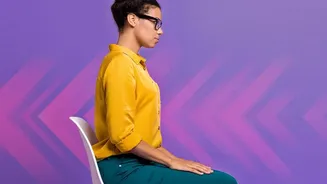
that uses a chair for support, making it perfect for an office environment. It helps improve flexibility, increase circulation, and reduce muscle tension by encouraging small, mindful movements throughout the day. Before you begin, take a moment to set your posture. Sit tall with your feet flat on the floor, your spine long, and your shoulders relaxed away from your ears.
1. Seated Cat-Cow
This move is excellent for improving spinal mobility and releasing tension in the back and neck. Sit on the edge of your chair with your hands on your knees. As you inhale, gently arch your back, moving your belly forward, lifting your chest, and looking slightly upward. This is 'Cow' pose. As you exhale, round your spine, tucking your chin to your chest and pulling your navel in, letting your mid-back press toward the back of the chair. This is 'Cat' pose. Flow between these two positions for 5-8 breaths, linking your movement to your breath to gently warm up the spine.
2. Gentle Neck Tilts
This stretch targets the tight muscles along the sides of your neck, known as the upper trapezius. Sit tall and slowly, gently tilt your right ear toward your right shoulder. Stop when you feel a comfortable stretch along the left side of your neck. To avoid strain, don't raise your shoulder to meet your ear; instead, let the shoulder relax downward. Hold for 15-30 seconds while breathing deeply. Slowly return your head to the center and repeat on the left side. Never force the stretch; gravity is all the pressure you need.
3. Chin Tucks
One of the most effective moves to counteract forward-head posture is the chin tuck. It works by strengthening the deep muscles in the front of your neck that often become weak. Sit straight and look directly ahead. Gently draw your head straight back, as if you are trying to make a double chin, while keeping your jaw relaxed and eyes level. You should feel a stretch at the back of your neck. Hold this position for 3-5 seconds, then release. Repeat this simple 'reset' movement 10 times. You can do this several times throughout the day.
4. Seated Spinal Twist
Twists are fantastic for releasing tension in the spine and shoulders. Sit tall and place your left hand on your right knee. Place your right hand on the chair behind you for support. As you inhale, lengthen your spine. As you exhale, gently twist your torso to the right, using your hands as gentle leverage. Turn your head to look over your right shoulder if it’s comfortable. Hold for 3-5 deep breaths, feeling the spine lengthen on each inhale and twisting a little deeper on each exhale. Unwind slowly and repeat on the other side.
5. Shoulder Rolls and Shrugs
We often hold stress in our shoulders, causing them to creep up toward our ears. This simple move helps to release that accumulated tension. On an inhale, lift your shoulders straight up toward your ears, squeezing them tightly. On the exhale, let them drop down completely, releasing the tension. Repeat this 3-5 times. Afterwards, gently roll your shoulders up and back in a circular motion for five repetitions, and then reverse the direction, rolling them up and forward for another five. This helps lubricate the shoulder joints and eases stiffness.
6. Seated Chest Opener
This pose directly counters the rounded shoulders common in desk work by opening up the chest muscles. Sit toward the front edge of your chair. Interlace your fingers behind your back. If you can't reach, simply hold onto the sides of the chair. Sit up tall, and as you inhale, straighten your arms (if clasped) and lift your hands away from your back, squeezing your shoulder blades together. Lift your chest toward the ceiling and feel the stretch across the front of your shoulders and chest. Hold for 15-20 seconds while breathing, then release.