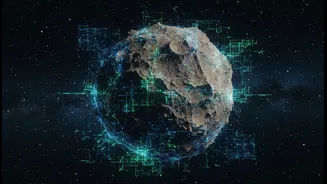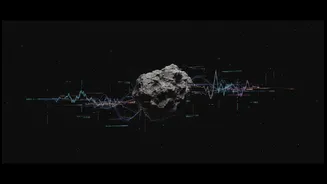




The Challenge of Cosmic Clutter
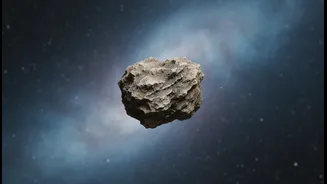
Spotting and tracking asteroids is a monumental task. Every night, telescopes around the globe scan the skies, generating vast amounts of data. However, not all data is created equal. A blurry image, an observation cut short by bad weather, or a simple
miscalculation can turn a harmless space rock into a perceived threat, or worse, cause a real danger to be overlooked. The initial detection of a faint moving light could be a new asteroid, a known one on a routine pass, or just an anomaly. Distinguishing between these possibilities requires high-quality observations and powerful analytical tools. This is where the challenge lies: sifting through the noise to find the clear signals that tell us an asteroid's true path and potential risk.
ESA’s Next-Generation Toolkit
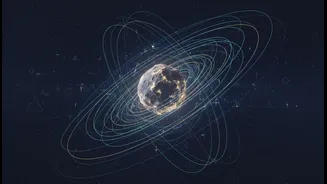
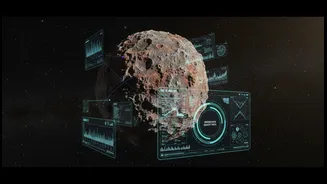
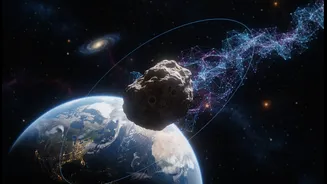
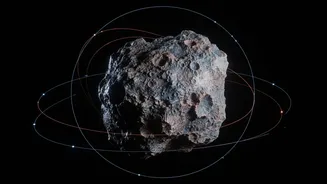
To tackle this data deluge, ESA's Near-Earth Object Coordination Centre (NEOCC) has developed and expanded a sophisticated suite of web-based applications known as the NEO Toolkit. Freely available to professional and amateur astronomers alike, these tools provide a clearer, more intuitive way to work with asteroid data. The toolkit includes several key components, such as the Orbit Visualisation Tool, which creates 3D models of an asteroid's path, and the Flyby Visualisation Tool, which simulates close approaches to Earth. A newer addition is the Synodic Orbit Visualisation Tool, which helps researchers quickly understand when and where an object might be observable from Earth. Together, these instruments empower users to not just see data, but to interact with it in a meaningful way.
From Raw Data to Reliable Alerts
One of the most significant hurdles in planetary defence is confirming a new discovery. An initial sighting provides only a tiny arc of an asteroid's full orbit. To determine if it poses a threat, astronomers need to observe it again. ESA's Observation Planning Tool is designed for this very purpose. It allows astronomers anywhere in the world to calculate the precise moments an asteroid will be visible from their location, factoring in variables to ensure the best possible viewing conditions. Another powerful instrument is the Sky Chart Display Tool, which generates a map of an asteroid's path across the stars. By making follow-up observations easier and more precise, these tools help scientists quickly gather enough data to calculate a reliable orbit. This process helps the NEOCC to maintain its Asteroid Risk List, a catalogue of all objects with a non-zero chance of impacting Earth, ensuring that real threats are monitored closely.
The Power of Collaboration and Open Data
While ESA develops these powerful tools, the entire field of planetary defence relies on global cooperation. Observatories, both professional and amateur, submit their findings to the Minor Planet Center, a central clearinghouse for asteroid data. The NEOCC then uses this information to refine its own risk assessments. The Gaia mission, while primarily a star-mapping project, has also been revolutionary for asteroid science. By creating an incredibly precise map of background stars, Gaia provides a perfect reference frame, allowing astronomers to measure asteroid positions and trajectories with unprecedented accuracy. Furthermore, some asteroid analysis platforms like ADAM, developed by the B612 Foundation's Asteroid Institute, are open-source, allowing for widespread collaboration in developing algorithms for impact probability and trajectory analysis. This open, collaborative approach ensures that the best minds and technologies are working together to protect the planet.