





Cosmic Time Capsules
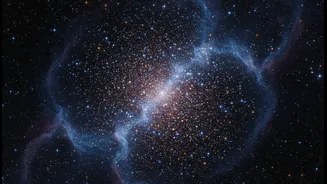
Dotted around our Milky Way galaxy are around 150 dense, spherical swarms of stars known as globular clusters. These are some of the oldest objects in the universe, with many forming just a few hundred million years after the Big Bang. Each cluster can
contain hundreds of thousands of stars, all tightly bound by gravity and born from the same primordial cloud of gas at roughly the same time. This makes them invaluable natural laboratories for astronomers. By studying the stars within a single cluster, scientists can piece together a snapshot of the chemical conditions and stellar processes of the very early universe, effectively looking back in time over 13 billion years. These clusters are cosmic time capsules, holding secrets to how the first stars and galaxies formed and evolved.
Unraveling A Surprising Complexity
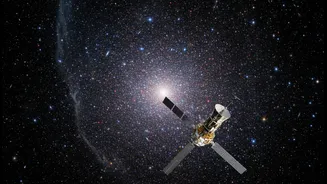
For a long time, globular clusters were considered simple stellar populations, where every star shared the same age and chemical makeup. However, the piercing vision of the Hubble Space Telescope has revealed a much more complex and fascinating picture. Recent observations of clusters like Messier 3 and NGC 6426 show that they often contain multiple, distinct generations of stars. This discovery challenges the old models, suggesting a more dynamic history. For instance, some clusters may be the result of two older clusters merging, or they may have experienced multiple bursts of star formation. Even more peculiar are the 'blue stragglers' found in clusters like M3—stars that appear unusually young and blue. Scientists believe these stars get a second lease on life by pulling material away from a companion star, making them hotter and brighter than their ancient neighbours.
The Global Science Network
These nuanced discoveries are not the work of a single astronomer peering through an eyepiece. They are the product of immense international collaboration. The Hubble Space Telescope is a joint project between NASA and the European Space Agency (ESA), with its data made available to the global scientific community. An astronomer at a university in one country might write a proposal to use Hubble's time, which is then peer-reviewed and selected by a committee at the Space Telescope Science Institute (STScI) in Baltimore. The raw data is captured and then processed, calibrated, and stored in archives like the Mikulski Archive for Space Telescopes (MAST). From there, teams of scientists from different universities and countries can access the data. This collaborative model is essential because modern astronomy has become a 'big data' science.
From Data to Discovery
A typical project involves a diverse team. A theorist might build computer simulations of how star clusters form, while an observational astronomer processes the raw Hubble images. Another specialist might focus on spectroscopy, breaking down the starlight into its constituent colours to determine a star's chemical composition. For example, a recent study of the cluster NGC 6397 combined data from Hubble, the James Webb Space Telescope (JWST), and ground-based observatories. This allowed a team from multiple institutions to analyse different stellar populations, from bright giants to faint M-dwarfs, creating a more complete picture. By combining data from different instruments and leveraging expertise from fields like physics, chemistry, and data science, these global teams can cross-reference findings, validate results, and slowly build a consensus on some of the universe's biggest questions.