






They Are Small and Incredibly Dark
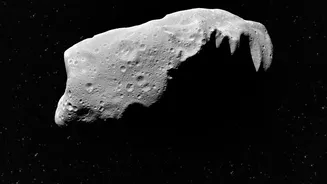
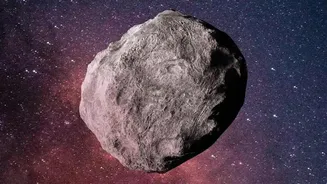
The most straightforward reason small asteroids are hard to find is right there in the name: they're small. Objects the size of a bus or even a building are minuscule on a cosmic scale. Unlike stars, they don't produce their own light. We can only see
them because they reflect sunlight. However, many asteroids have very low albedo, meaning they are darker than charcoal and reflect very little light, making them incredibly faint targets for telescopes. Unless an asteroid is very large or passes very close to Earth, it remains a faint speck against the infinite black backdrop of space, easily missed by even powerful surveys.
The Sun Creates a Massive Blind Spot
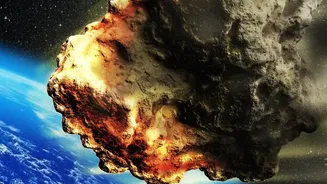
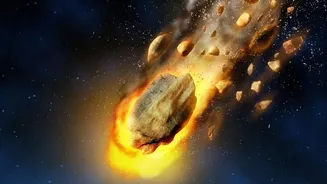
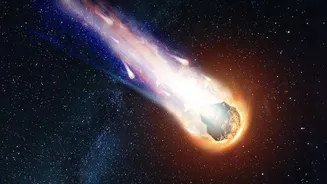
One of the most significant challenges in asteroid detection is the Sun. Telescopes on Earth are blinded by its glare, creating a vast region of the sky where detection is nearly impossible. An asteroid approaching Earth from the direction of the sun is effectively hidden in daylight until it's practically on top of us. This was the case with the 2013 Chelyabinsk meteor, which went completely undetected before it exploded over Russia. A rare class of asteroids, known as Atens, have orbits that are mostly within Earth's, meaning they spend a great deal of time in this solar blind spot, posing a unique and sneaky threat.
The Sky Is Big and They Are Fast
The sheer scale of the sky presents a monumental challenge. Even with dedicated sky surveys scanning the heavens, it can take a month to cover the entire visible sky just once. These surveys must find a tiny, fast-moving object in an ocean of data. Asteroids travel at incredible speeds, often tens of kilometers per second. This means they cross a telescope's field of view very quickly, offering only a brief window for detection. If a telescope isn't looking in the right place at exactly the right time, the opportunity is lost. This is why many close-passing asteroids are only discovered days or hours before their nearest approach.
Complex Orbits and Unknown Composition
Predicting an asteroid's path requires multiple observations to calculate its orbit. For small, faint objects, getting enough data points quickly is a race against time. Their trajectories can be influenced by the gravitational pull of planets, making long-term prediction difficult without precise tracking. Furthermore, we often don't know what an asteroid is made of until we can study it up close. Some are solid chunks of iron, while others are brittle piles of rubble. This composition affects not only how it reflects light but also how it would behave upon entering Earth's atmosphere, determining whether it burns up harmlessly or poses a threat on the ground.
How We Are Improving Our Odds
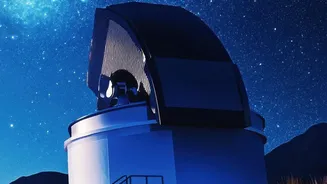
Despite the challenges, planetary defense is a rapidly advancing field. Global networks of observatories like the Catalina Sky Survey constantly scan the skies and share data to confirm new objects. Upcoming projects like the Vera C. Rubin Observatory are expected to dramatically increase our detection capabilities, finding many more faint asteroids than previous surveys. Furthermore, innovative techniques are being developed to find even smaller objects by sifting through data from telescopes like the James Webb Space Telescope. Missions like NASA's DART (Double Asteroid Redirection Test), which successfully altered an asteroid's trajectory, have proven that with enough warning time, we have the ability to defend our planet.